

























One topic at a time
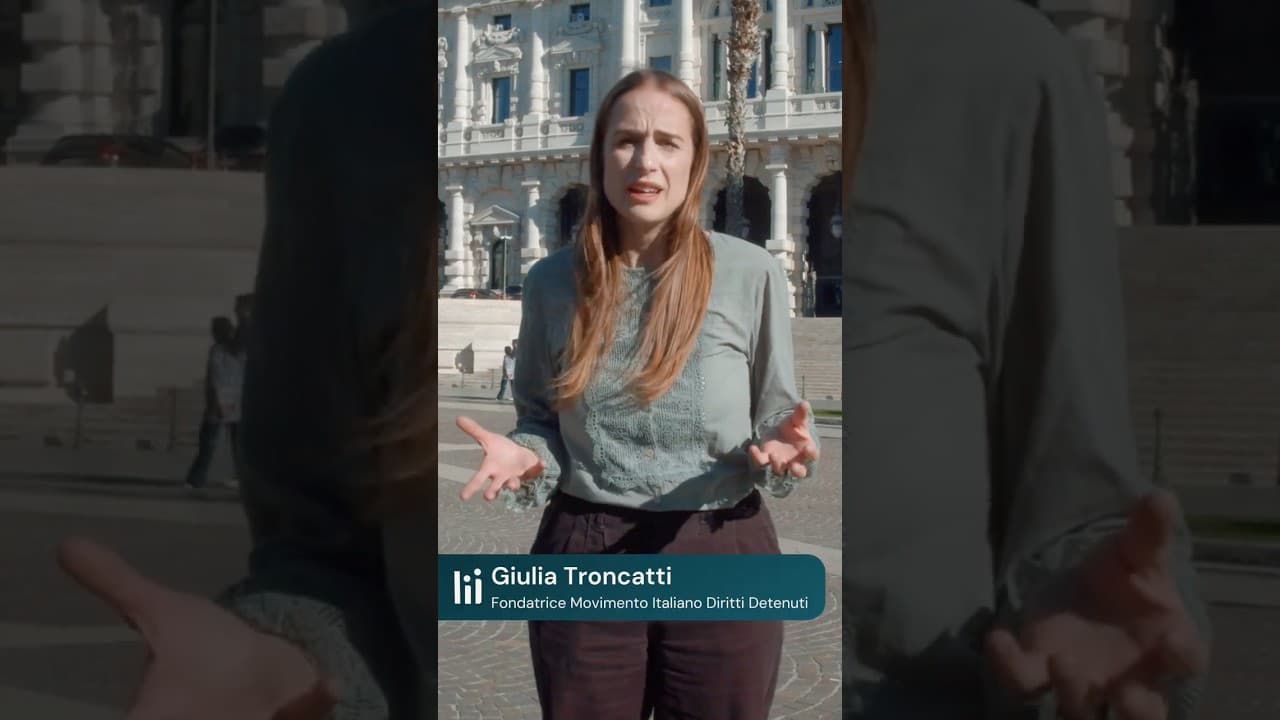
Giulia Troncatti
In one minute, Giulia Troncatti explains how prison works and where reality drifts away from the law.
Who is Giulia TroncattiAffective bonds
The video reflects on the use of mobile phones in prison, between emotional needs and repressive policies, inviting discussion on possible solutions.
Did you know that hundreds of phones enter Italian prisons every year? In 2024 alone, 2000 have been found.
And consider that since 2020, finding a phone on a detained person has become a crime, so there is a risk of 1 or 4 more years of imprisonment. In addition, of course, to all the other sanctions provided for, such as for example a disciplinary sanction, a transfer, the possibility of losing early release and therefore a reduction of sentence.
But why should a detained person risk so much or have a phone? The first answer that comes to mind is obviously to maintain criminal dealings with the outside from inside the prison. This can be an option, but not the only one.
If we remember that detained people are people, indeed, perhaps we could also ask ourselves if these phones are not also a way to maintain emotional ties with the outside and therefore hear from family, beyond that hour of phone calls per month that we mentioned in another content on this channel, being what is provided for according to the prison administration regulations.
In an article for alianews.it, the guarantor of detained persons of Campania, Ciambriello, recounts how there are 26 countries in Europe in which detained persons are allowed a greater number of calls, even up to one per day, while in Italy we persist in carrying out repressive policies also through signal jammers.
One in particular that the guarantor mentions is precisely the one that was installed at Secondigliano in Naples, where even the government boasted of having intercepted 24,000 frequencies.
Ciambriello in the article criticises this position, arguing that it is actually an advertising spot, because the signal jammer would have disturbed not only the phones of detained persons, but those of the entire neighbourhood, as well as the prison police and all the people who work inside the institutions.
Furthermore, we want to leave you with this question and ask you to join us in the debate in the comments, namely do you think it makes sense to implement repressive policies that at best disturb the signal of an entire neighbourhood or would it be more useful to increase the number of calls allowed to detained persons to discourage the spread of phones inside penal institutions?
One topic at a time
Giulia Troncatti