6 visits
a month at most, in person
Art. 37 of the Implementing Regulation (D.P.R. 230/2000)
The law recognises the right of people in prison to keep in touch with their family through visits, phone calls and letters. Since 2024, the Constitutional Court has also recognised the right to private intimate visits with a partner, without visual supervision.
Arts. 18 and 28 of the Prison System Act · Constitutional Court, judgment no. 10/2024
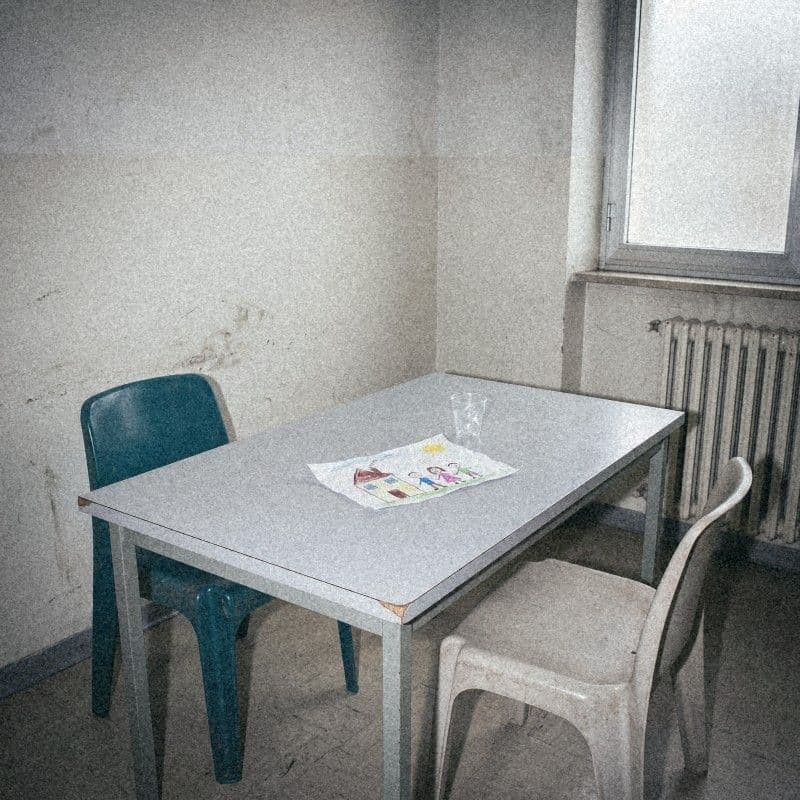
Being the mother or father of children who are born and grow up. Being the son or daughter of parents who grow old. Being the partner of the person who chose to build a life together. All of this becomes impossible.
6 visits
a month at most, in person
Art. 37 of the Implementing Regulation (D.P.R. 230/2000)
1 hour
at most per visit, up to 2 if the family lives in another municipality
Art. 37 of the Implementing Regulation (D.P.R. 230/2000)
10 minutes
at most per phone call, 6 a month
Art. 39 of the Implementing Regulation (D.P.R. 230/2000)

WHAT THE LAW PROVIDES
Under Article 27 of the Constitution, punishment may not consist of inhuman and degrading treatment.
But severing a person's emotional bonds means destroying them.
Article 18 of the Prison System Act establishes that visits take place in supervised spaces, in full view of the officers, often in crowded rooms. People in prison have no right to privacy when they meet their loved ones.
6 hours per month at most. Each visit lasts at most one hour. With relatives or partners living in a municipality other than that of the prison, it can last up to two hours, if there have been no visits in the previous week and the organisation of the institution allows it. In exceptional cases, the prison management can authorise an extension.
Article 18 of the Prison System Act and Article 37 of the Implementing Regulation (Presidential Decree 230/2000)
For convicted people, the prison director. For those awaiting first-instance judgment, the judicial authority handling the case.
Article 37 of the Implementing Regulation (Presidential Decree 230/2000)
Relatives may be hundreds of kilometres away from their loved one in detention, and often cannot afford, in money or time, to travel for a 2-hour visit. Maintaining affective bonds becomes impossible. Sexuality, in practice, is still denied.
For people convicted of high-security offences, that is, offences considered particularly serious, monthly visiting hours are reduced from 6 to 4. Phone calls are reduced from 6 to 4.
For people held under the 41-bis regime, the near-total isolation regime provided for the most serious organised crimes (mafia and terrorism), monthly visiting hours are reduced from 6 to 1. The visit takes place behind a glass partition: no form of physical contact is allowed. A person can remain under 41-bis for decades. Phone calls are reduced from 6 to 1.
Article 41-bis of the Prison System Act
Through phone calls: 6 a month, 10 minutes each at most. Then there are letters, a slow and outdated tool that hardly anyone outside uses any more. People in prison cannot keep a personal phone and have no access to the internet.
Article 39 of the Implementing Regulation (Presidential Decree 230/2000)

CONSTITUTIONAL COURT, JUDGMENT NO. 10/2024
On 26 January 2024 the Constitutional Court declared Article 18 of the Prison System Act unconstitutional. The reason: not providing for the possibility of private intimate visits with a partner violates the fundamental rights of the person. The Court referred to the Constitution and the European Convention. It said that sexuality and affectivity are not a luxury: they are rights. And more. The Court stressed that “affective desertification” is “the exact opposite of resocialisation” (judgment no. 10/2024) required by the Constitution.
Yet more than a year later, Parliament has still not legislated. The ruling exists. Its implementation does not. Initiatives to create “affectivity rooms”, which guarantee private spaces for visits between partners, are left to individual administrations. The result is substantial inaction.
“The intimacy of affections cannot be sacrificed by the execution of a sentence beyond what is necessary, otherwise the sanction is perceived as excessively afflictive, so that it cannot tend towards the goal of re-socialisation.” - Constitutional Court, judgment no. 10/2024
Are you the partner of a person in prison? Here is what you can do
If the prison where your partner is held has no affection room, you can file a judicial complaint with the supervisory judge (Magistrato di sorveglianza) under Article 35-bis of the Prison Administration Act. Affection is a right, and the Constitutional Court has said so. Ask the State to respect it.
IN DEPTH
Who pays, besides the person in prison, and why cutting visits is the wrong choice.
When the right to affection is not guaranteed, it is not only the people who committed the offences who are punished, but also their families. Partners, parents and children often pay a very high price, through no fault of their own. The whole family suffers the trauma of separation. For young children, the harm is often deep and lasting.
Cutting the number of visits according to the seriousness of the offence reflects a logic of rewards that should not be applied to rights. Formally, a prison sentence should only suspend freedom of movement, but these examples show that every area of life, for people in prison, is held to ransom. The seriousness of the offence should have no effect on how much time a person can spend with their loved ones.
Prisoners cannot keep a personal phone and have no access to the internet. Prison means total disconnection from the outside world. The few hours of in-person and phone visits are the only moments when prisoners can hear the voice of their loved ones.
In 2012, with judgment no. 301, the Constitutional Court had declared inadmissible the challenge concerning prisoners' right to affection and sexuality, while urging the legislature to act. Twelve years later nothing had changed.
This page explains how the Italian prison system works; it does not replace a lawyer’s advice.
Leave permits, semi-liberty, probation: the path set out by law.
Reducing the sentence and speeding up every benefit: a mechanism worth knowing.
The 3 square metres in a cell are a right, with compensation if violated.