


















One topic at a time
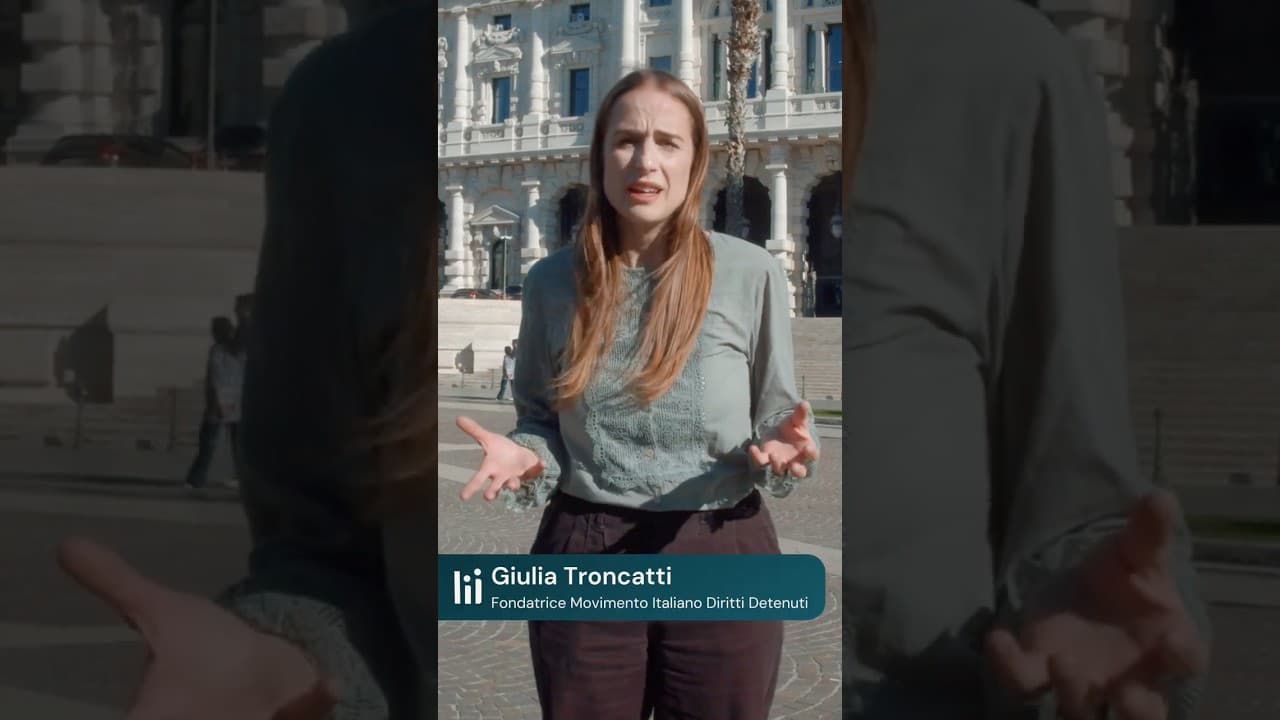
Giulia Troncatti
In one minute, Giulia Troncatti explains how prison works and where reality drifts away from the law.
Who is Giulia TroncattiCompensation for overcrowding
The 41 bis regime isolates the leaders of organised crime in single cells, with social interaction and family contacts strongly limited and controlled.
Today we are talking about 41 bis. Have you ever heard of the so-called hard prison? The 41 bis is a special regime that was introduced in Italy after 1992, the year in which there was the famous Capaci massacre in which Giovanni Falcone died.
Therefore, in fact, this form of hard prison was introduced to contain the mafia phenomenon which in those years was obviously spreading in a forceful manner. The 41 bis is designed to accommodate the heads of organised crime, therefore the heads of the mafia, camorra, 'ndrangheta and terrorism.
In April 2026 the people detained under 41 bis were 741 and these were all Italian, apart from six people. The number of 741 people is also limited compared to the number of people convicted overall for organised crime which is around 9,000 units.
So in fact the 41 bis accommodates only the leaders of organised crime. Precisely for this reason the 41 bis is absent in some Italian regions that have been particularly affected by the mafia phenomenon such as Campania, Puglia, Calabria and Sicily.
But what is life like inside 41 bis? The people detained spend the whole day in their cell, which is a single cell, and can have a moment of sociality only with three other people who are chosen by the prison administration. The hours of outdoor time today are four, but they have been reduced recently following a sentence of the Constitutional Court of 2025 which underlined that the only two hours of outdoor time that were previously provided were an excessively afflictive form of punishment, thus bringing the number to four.
Visits with the family within this regime are one per month of one hour and can be replaced with a 10-minute phone call. Everything is obviously recorded and the visit is done through a glass.
The placement of a person detained under 41 bis is by the Ministry of Justice and lasts every 4 years with the possibility of renewal every two. In fact, renewals are almost automatic, in the sense that if we look at the statistics for 2025 we see that prison 2 was extended for 232 people, while only five have been downgraded and therefore have moved to a less severe detention regime.
Today we have people who have been inside 41 bis for 20 years, even more, and even Italy has already suffered a conviction from the European Court because there have been extreme cases in which it managed to keep a ninety-year-old person with Alzheimer's still within this detention regime.
To talk about 41 bis in Italy means to open an important debate because some think that a hard prison is the only form of deterrent for organised crime.
In reality today the question we ask you is: can the existence of such a hard prison be consistent with the educational aims of punishment?
One topic at a time
Giulia Troncatti