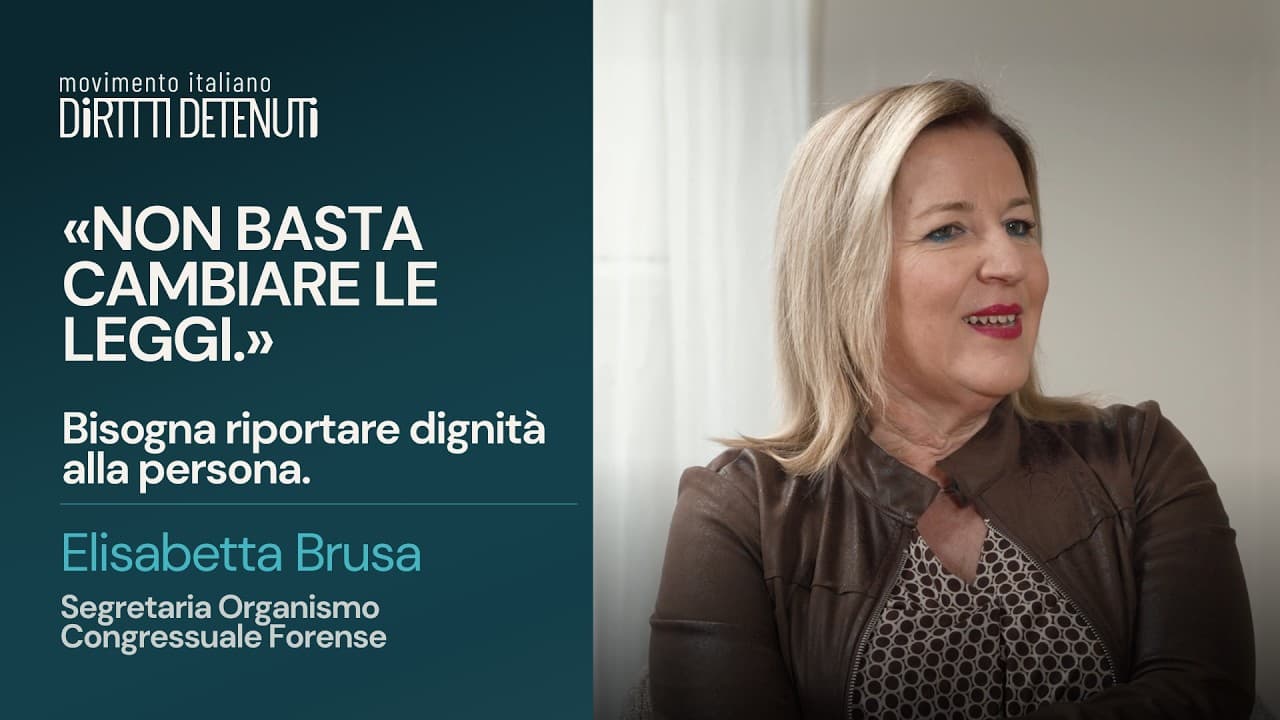
Elisabetta Brusa reflects on dignity and rights in prison, emphasising the role of technology in facilitating access to information.
What does it mean to protect the person in prison
It is necessary to bring attention back to all politics and also to prison construction regarding how the individual inside the prison lives.
Lawyer Elisabetta Brusa, thank you for accepting our invitation. For 20 years a cassation lawyer, does that mean you get where others have struggled a bit more?
It means that due to age, unfortunately, I have the qualification to exercise my role as a lawyer also at the Court of Cassation, which is the highest level of judgement where my clients can obtain justice.
When you chose, did you choose the law or the search for truth?
I have always chosen protection, so it is something that goes beyond both the law and the search for truth. I have always wanted – in all my defences – to help find the truth in the law, but protecting that person and I have always seen people, never numbers or files.
Is the truth a truth or is it a negotiation?
It is always truth. I do not believe it can be a negotiation.
Do you know the prisons in Italy?
I know many, I have visited many and I have
What does not work in Italian penitentiary institutions
I had the opportunity to be responsible for a commission within the forensic congress organisation, which is the political body of the Italian legal profession and which allowed me to do something for prisoners and therefore to try to improve the prison structure in Italy.
People know prisons often by hearsay, through someone else, through the media system, through newspapers, through controversies. What works and what does not work in there? I tell you as someone who enters Italian prisons daily: there is a great deal that does not work.
There are many issues related both to prison construction and to the ways in which people approach the prison world. It is not just a political issue, so it is not just about having to change, trying to change the laws regarding detention measures, it is also about entering the prison and trying to give dignity to the person.
Attention must be brought back to all politics and also to prison construction regarding how the subject inside the prison lives. Does it apply to a murderer and to a bicycle thief? Absolutely it applies to every man and woman who encounters the world of detention: they must be put in a position to freely exercise their rights.
They must be put in the position to be able to do their shopping.
A woman must be put - a woman - in the position to be able to look at herself in a mirror and this is not demagogy. A woman is forbidden to bring a mirror inside her own detention cell and so it is these small things that deprive the subject of their ability to be considered a human person.
Technology
Technology and access to rights: free tools for detained persons and families
he/she can come to the aid of a colleague, of a detainee, of the family of a detainee, with artificial intelligence they can modify something that already exists.
The same congress motion on the electronic file - there had also been a congress motion, then turned into a recommendation - on the use of artificial intelligence in the surveillance magistrate, so even more it is clear how much we need - as lawyers - to expand the use of this artificial intelligence for the detainee.
For example, the site that calculates the End of Sentence - finepena.it - is a very useful site for lawyers because we are talking about a subject which is the subject of penal execution that not all lawyers know, so already there are few of us who do it and obviously a site of that type certainly helps us as well to give much more reliable answers regarding the calculations to our client, but simply it can also be used - because it is a very very easy and usable site by the detainee's own family members.
So, when there is even the simple doubt of not knowing the end of sentence that one's family member will have, it is important to have systems like those to consult.
Thank you lawyer for being with us.
Thank you for giving me the opportunity to talk about it. I believe it is clear, it is a great passion and I would really like to be able every day to do something more because I really believe it is a topic that must be talked about and above all must continue to be talked about.
I always say it. Thank you for allowing me to continue talking about it.
What it covers
Laws cited
- Art. 27 Constitution — It establishes that punishments must aim at the rehabilitation of the convicted person and prohibits treatments contrary to the sense of humanity.
Keywords
- prisoners' rights
- dignity
- prison construction
- artificial intelligence
- penal execution
- families of prisoners
- electronic file
Who speaks
Elisabetta Brusa
The right at stake: early release
More videos on this right
Doing Business in Dozza: Prison Work That Cuts Recidivism
Valerio Monteventi