The project offers qualified work to prisoners, reducing recidivism and supporting reintegration, also against the risk of expulsion.
The return to prison and the prospects
Those who go to prison and have no prospects return there 75% of the time. If another prospect is created, like the one we are working on, they return 10% of the time.
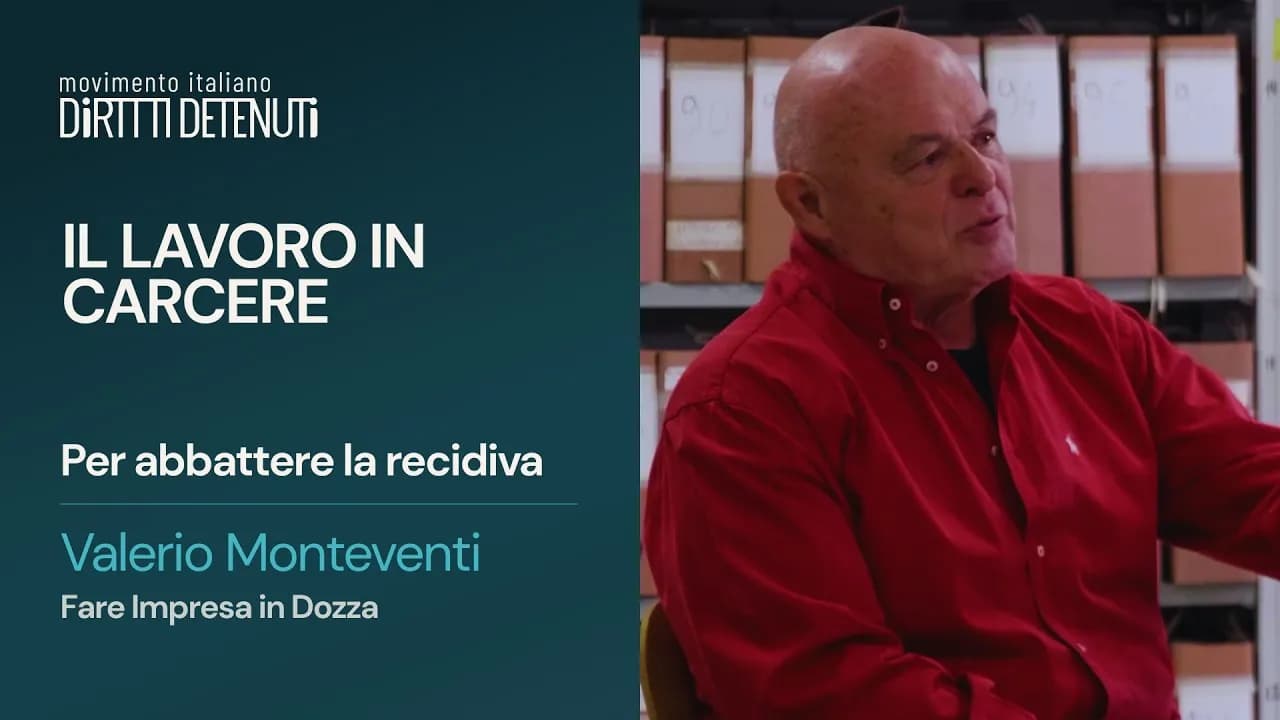
Presentation by Valerio Monteventi
My name is Valerio Monteventi. I was in prison in 1980, one year of pre-trial detention, then afterwards I was acquitted due to subsequent lack of evidence and in any case I got to know the reality of prison.
From that moment I have dealt with prison issues.
Reasons to participate in the project
I decided to take part in this project because it seemed to me a serious project. It also started following a discussion that had taken place in the city and starting from a conference "prison and work" and then some forces joined together. Firstly, it involved three large metalworking companies in the packaging sector which are I and Marchesini Group who decided to support this project which consists in the opening of a mechanical workshop inside the prison.
Currently there are eh 17 prisoners with definitive medium-long sentences employed. The particularities of this project are several. The first is that there is a participation of former workers from these three companies, people who worked as travelling assemblers, turners or millers who decided to participate in rotation and carry out the function of tutors towards the young prisoners, in the sense that first of all they teach them the job, they transmit professional skills to them.
The second aspect is that these detained people are employed with the national metalworkers' contract, they work 30 hours a week over 5 days for salaries that range from €1200 to €1300.
The most important situation
The third situation, from my point of view the most important, is the one that then allowed me to make this choice: it is to create the conditions to let them out on an alternative measure or at a quarter of the sentence. Very rarely born a third of the sentence or half the sentence.
Since the project started, 67 prisoners have been released so far. They have also been released with significant residual sentences, from 6 to 7-8 years. In some cases seven people have returned and there has been, eh, a recidivism rate around 11%, compared to a normal recidivism rate which is usually about 70-75%.
This for us, let's say, in some way is the demonstration that if serious paths are built with projects that also give a significant life perspective, the results can be achieved much more than all the talk about security that has been going on daily for a certain number of years now.
Another important aspect of our project is to follow the prisoner also precisely in the phase after prison, but also in a phase after the end of the sentence, in the sense that the majority of prisoners who participate in the project are of migrant origin and therefore for the crimes they have committed almost all of them are part of these crimes as regards the immigration law, the Bossi Fini, at article 4 in the list that provides for expulsion at the end of the sentence.
In some cases expulsion is in some way also provided for within the sentence. So, our work is as regards these people who have in some cases done 4 5 6 years of alternative measure who, eh, have found a job that has satisfied them and so they are rebuilding a life, they run the risk that when the sentence ends, they find the police who take them, take them to the border for expulsion or to a detention centre for migrants, in a CPR.
So, our work is when there is a period of time left of about a year, a year and a half before the end of the sentence, to start with the contribution of lawyers, lawyers expert in immigration law, to have this path recognised, first going through the justices of the peace, then going through the surveillance court, to have the expulsion removed. We have managed in most cases, even if you have to deal with the political situation which has certainly worsened.
So, that is, when someone has finished the sentence, it is not that they have finished, in inverted commas, paying the debt to the State.
A whole other series of issues, one of which, for example, very often together with the custodial sentence, and there is also an accessory pecuniary penalty or there are the legal costs which, as long as you are in prison and do not have a job, are set aside, but as soon as you have a job the Revenue Agency shows up and imposes that a fifth of your salary is taken and so 40, 50, €100,000, sometimes even more of pecuniary penalty, this thing remains with you for life.
What it covers
Laws cited
- Art. 27 Constitution — It establishes that punishments must aim at the rehabilitation of the convicted person.
- Art. 4 Bossi-Fini Law — It provides for expulsion for foreigners convicted of certain offences.
Keywords
- recidivism
- reintegration projects
- work in prison
- alternative measures
- expulsion
- ancillary penalty
- prisoners' rights
- migrants
Who speaks
Valerio Monteventi