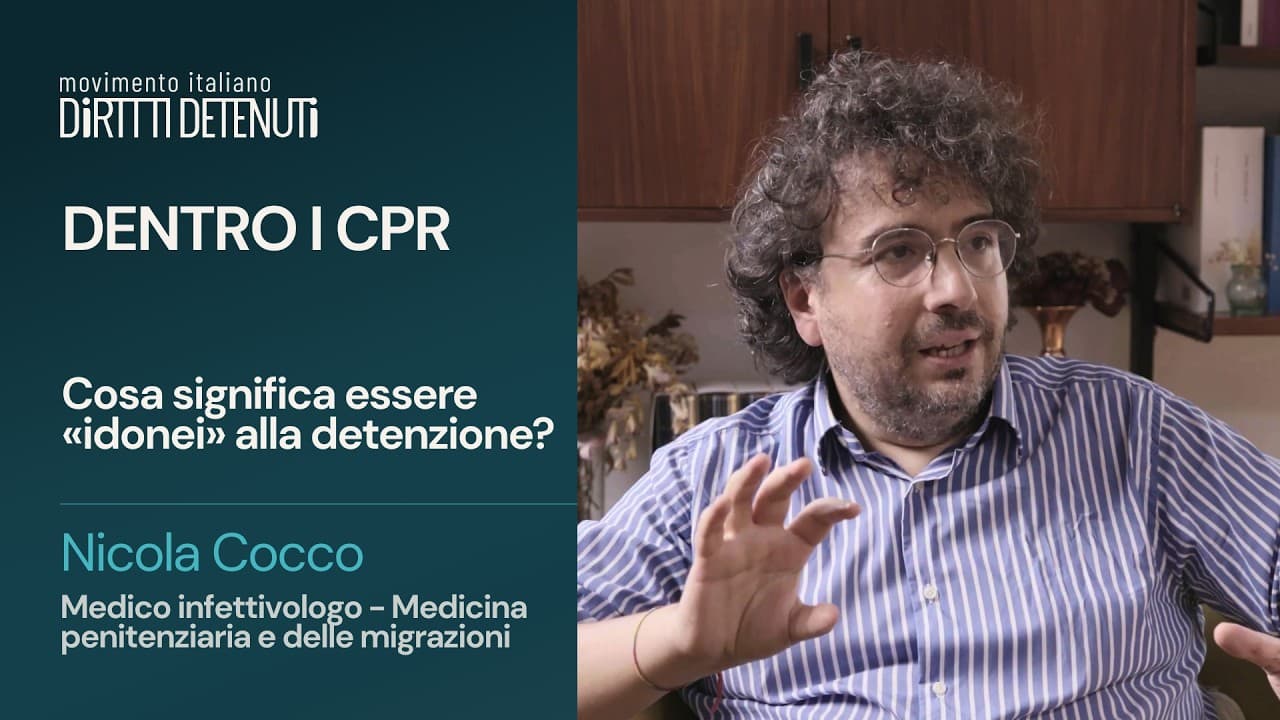
In the CPR, the assessment of suitability often ignores serious health risks, exposing migrants to pathogenic conditions and violations of rights.
Personal experiences in CPRs
I have never seen in the CPR a person who appears or perceives themselves or says they are well. The CPR are the centres for permanence for repatriation and are the places where migrant people considered irregular are detained in order to then be forcibly repatriated. Well, this is the, eh, aseptic definition that the government might give you.
In reality, they are places of detention where migrant people considered irregular are relegated for the detention itself, because repatriations are carried out in less than half of the cases and the living conditions inside these centres present critical issues regarding respect for human rights that are now well known at an international level.
The European Committee, eh, for the respect against inhuman degrading treatment, torture, has spoken about it. The World Health Organisation has spoken about it, there are hundreds of testimonies and in fact for some people they represent a continuum of detention from prison.
Data and research on CPRs
According to the data from the "Trattenuti" research by Action Aid of the University of Bari, at least 17% of the people who are in the CPR come directly from prison at the moment of release. These are those people of foreign origin who during imprisonment do not have the luck to have a lawyer who renews their residence permit or gets it done for them.
And so what happens? They finish their detention in prison, I have seen it happen right outside the prison door, at the prison gate. The police take them, put them in the van and take them to the CPR where another detention begins, but with characteristics that are worse compared to prison.
The CPR is completely excluding towards society and the problem is that even the right to health is completely disregarded. Let us remember that these are places managed by private entities. In some cases they are large multinationals like Mediospes or in some cases they were cooperatives like Martinina which ended up on trial in Milan for the mismanagement it had.
That mismanagement which I would dare to say is structural to the functioning of the CPRs themselves, includes the right to health and the doctors and nursing staff are hired directly by this managing body, so there is no monitoring or coordination function from the public sector. So these doctors find themselves in a sort of limbo inside these centres and the right to health is not enforced.
I always summarise by saying that these are places of great suffering and abandonment. The regime of abandonment, to return to Basaglia, is precisely the one where your deprivation of liberty which is carried out by the State not to help you, but to segregate you from society, has no life horizon. Because while in prison there is the issue of the offence and then the issue of social reintegration, in the CPR this does not exist, because in theory you are not supposed to return to society. You are supposed to be repatriated, but the concept of repatriation is probabilistic and so you are constantly subjected to a series of anxiety-inducing, depression-inducing and other such stimuli, which is the reason why in itself the administrative detention of migrants is considered pathogenic, but this is from the international scientific literature.
We have been reporting this for more than 3 years now, considering that the World Health Organization itself has published reports on this pathogenicity.
Public and media response
Yet we see the answer in the newspapers every day, don't we?
The CPR is presented as a sort of model for managing immigration in the era of the new European pact on immigration. I have met migrant people who have collected in their curriculum a period of imprisonment in a penitentiary institution and then perhaps seven stays in a CPR because their life basically becomes this continuous negotiation between irregularity which becomes illegality due to the Bossfini law. Basically, it is life inside these centres where once he tried to, since I am talking about a real person, once he tried to commit suicide, another time he broke a leg, another time he had Rivotril poisoning, obviously addicted to Rivotril as a result of all these imprisonments.
But the funny thing is that in the end they repatriated this person to Tunisia and he came back to Italy and did CPR two more times. And in the CPR this shows how in reality it is simply propaganda to present it as a tool of, eh, eh, contrast to illegal immigration. I use vulgar terms because the government uses them, eh, just to understand what we are talking about.
Repressive function of the CPR
And in reality it is a tool of, uh, repression and erasure of migrant people that violates rights and human dignity. That is, let us remember, the fact of being deprived of liberty not for having committed a crime, but for the, uh, the ontological issue of being considered irregular because you do not have a piece of paper, because you do not have the residence permit.
Therefore, well aware of these pathogenic issues, since 2022 some entities, in particular the National Guarantor of the rights of persons deprived of personal liberty, has strongly suggested to the Ministry of the Interior to include an assessment of suitability for life in that restricted community which was precisely to exclude people with health issues of any kind, uh because they know very well that in that context a health issue is exacerbated and can lead to extremely difficult management complications if not to death, uh, because CPR people have died.
But what happened? That this assessment in the vast majority of cases has become a clearance. As such it was requested, is requested, for example, by the by the by the police when they go to an emergency room, because this assessment must be done by a doctor of the national health system.
What happens? Since it must be done 24/7, right? It is an emergency to take a person to a GPR, uh, they are taken to the emergency room. The emergency room doctor finds two police officers arriving, all pumped up, who say "Doc, leave us the", uh."
Direct testimonies and stories
These are scenes witnessed, eh, leave us the clearance because we have to take this to the reception centre, because often they do not say at the CPR.
With this pressure, without cultural mediation, without written informed consent, a rough assessment is made which in the vast majority of cases, but I am really talking about 99% of cases, results in saying does not present infectious or contagious problems and therefore is suitable for life in the CPR and in this way they have ended up in the CPR. People with chronic illnesses who have decompensated, diabetics who have ended up in hospital, people who after a few hours broke an arm in order to have a reassessment of this fitness.
Musabalde ended up there, who died by suicide, suicided inside the CPR. Usmansilla ended up there, to mention a few names, right?
Recent cases of suffering in CPRs
That Jussef Abdelatif was exhausted and very recently Ossaed Doui, Souet Dowi who is a person of Moroccan origin who, while I was down in Basilicata, near Palazzo San Gervasio, sent me a self-harming gesture because he wanted to pretend to commit suicide, fell from a scaffolding and died.
And so all these people were considered suitable to stay in the CPR. What is the paradox of our society? That while some organisations dealing with migrants' health have launched a campaign in which they ask doctors: look, that is a pathogenic place, it is a place that has been described as torturing at an international level, can even healthy people be considered suitable for a pathogenic or torturing place.
What happened? That some doctors who took part in this campaign gave unsuitability to the CPR, they were investigated for ideological falsehood, in particular in Ravenna last February, while all the doctors who issued suitability for people who then died, committed suicide or had enormous problems in the CPRs, no one ever looked for them.
But I do not want them to be investigated. I mean, the investigation is not the instrument, discussion is the instrument, the fact of saying "But is it normal that we give suitability to a person to go to a torturing place?" Here, this is the question that we have raised at a social level.
What it covers
Laws cited
- Art. 27 Constitution — It establishes that criminal responsibility is personal and that punishments cannot consist of treatments contrary to the sense of humanity.
- Bossi-Fini Law (L. 189/2002) — Legislation regulating immigration and the stay of foreigners in Italy, introducing restrictive measures and detention in CPRs.
Keywords
- cpr
- administrative detention
- human rights
- right to health
- migrants
- forced repatriation
- psychological suffering
- bossi-fini law
Who speaks
Nicola Cocco
The right at stake: compensation for overcrowding
More videos on this right
Giachetti: “Prisons are pigsties”
Roberto Giachetti