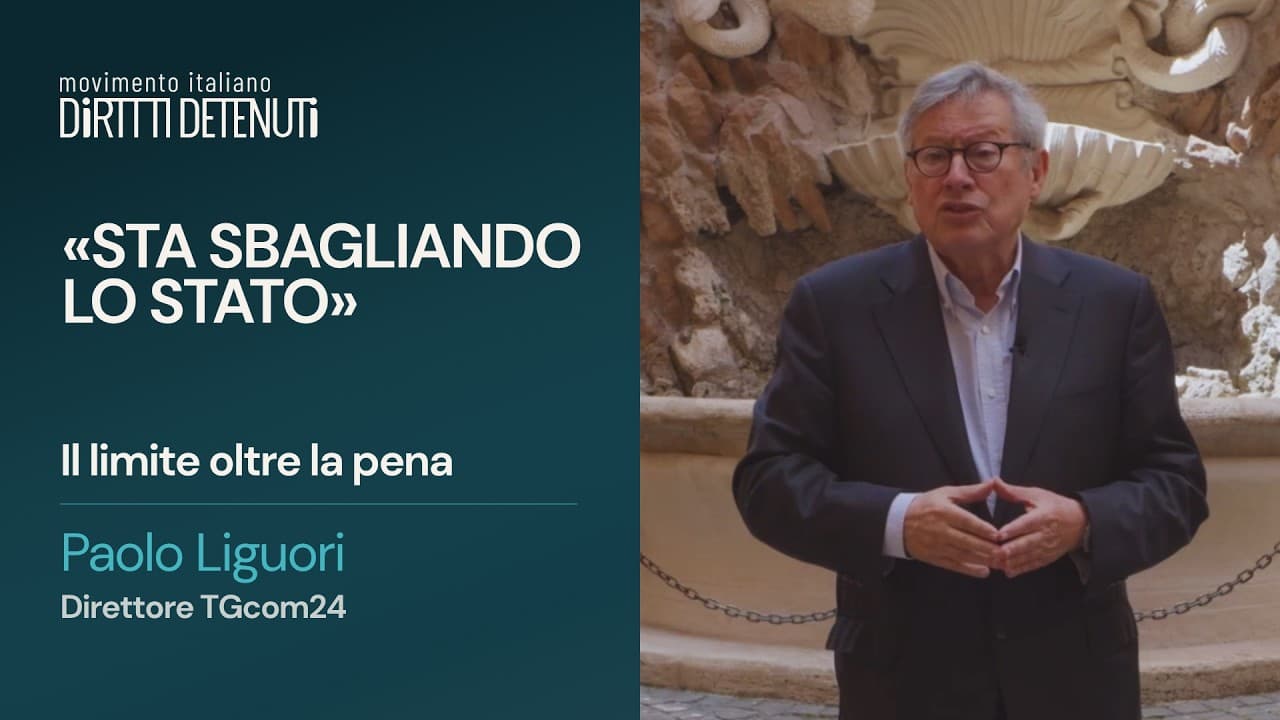
Paolo Liguori reflects on the need for a more humane prison, condemning torture and recalling the nonviolent legacy of Marco Pannella.
The problem of torture in prison
In the meantime, there should not be torture in prison and that is a big problem to address immediately.
The lesson of non-violence by Marco Pannella
The one that struck me the most, the one Marco Pannella taught me, was the battle of non-violence. So Nessuno tocchi Caino. It is a bit difficult because here we are talking about people who are locked up, people who have been sentenced, people who have tasted, savoured violence, but who must find other outlets.
However, to do this, the important battle that I share, I subscribe to – I am a member of Nessuno tocchi Caino – is the battle for a much more humane prison condition.
Now the tendency could be not to have prison, but since everyone explains to us that this is utopia, in the meantime there should not be torture in prison and that is a big problem to address immediately.
Where we see that prison becomes torture, it is wrong. The State is wrong, the application of the law is wrong.
Constitutional rights and models of justice
It is a constitutional right to have prison, but not torture. I do not know how to answer this question. The European models of justice are models of justice. Every time I get involved, every time I see one, none of them suit me. Probably if we went outside Europe it would be even worse. So the problem is that there is not the model of justice that we should have – it should be measured on our country. But if I measure it so generically on public opinion, I risk that people say "Ah, we need an even tougher prison, we need to throw away the key." These are the models I hear at the bar.
Criticism of models of justice
They are terrifying models. If I didn't know that they are all nonsense, fake things.
Then the people who tell you they should throw away the key, as soon as something happens they come to you, they say "Will you give me a hand because I have been wrongly accused like thousands of others."
Towards a more humane prison
So I cannot indicate what model would be needed. I can indicate that, on a human level, we should approach the issue of prison with more openness.
Well, I will indicate one thing. What should be done is that everyone should take more interest in prison, because prison is not only a place of detention, but it is a place of detention that society tends to keep closed and distant. If people knew that it was under their house, inside their house, as happens to some, they would become a bit more easily moved, understanding, sensitive, humane and I would like this.
The memory of Marco Pannella
The memory of Marco Pannella is not there. Marco Pannella is alive, his ideas are still alive, there is no memory. Memory, the memory each of us has of Marco Pannella, of his life, exists for those who knew him, for those who fought battles with him, the memory is ours, but not many people fight his battles anymore, no one does them anymore, there are no longer any interpreters of that radicalism of Pannella that disrupted politics, entered it, influenced it, gave birth to and nurtured ideas that were well ahead of their time.
And they are also beyond our times and today there would be a need for those battles, not for the memory of Pannella.
What it covers
Laws cited
- Art. 27 Constitution — It establishes that punishments must aim at the rehabilitation of the convicted person and prohibits treatments contrary to the sense of humanity.
Keywords
- torture in prison
- non-violence
- Marco Pannella
- constitutional rights
- models of justice
- humane prison
- memorandum
- society and prison
Who speaks
Paolo Liguori
The right at stake: compensation for overcrowding
More videos on this right
Giachetti: “Prisons are pigsties”
Roberto Giachetti