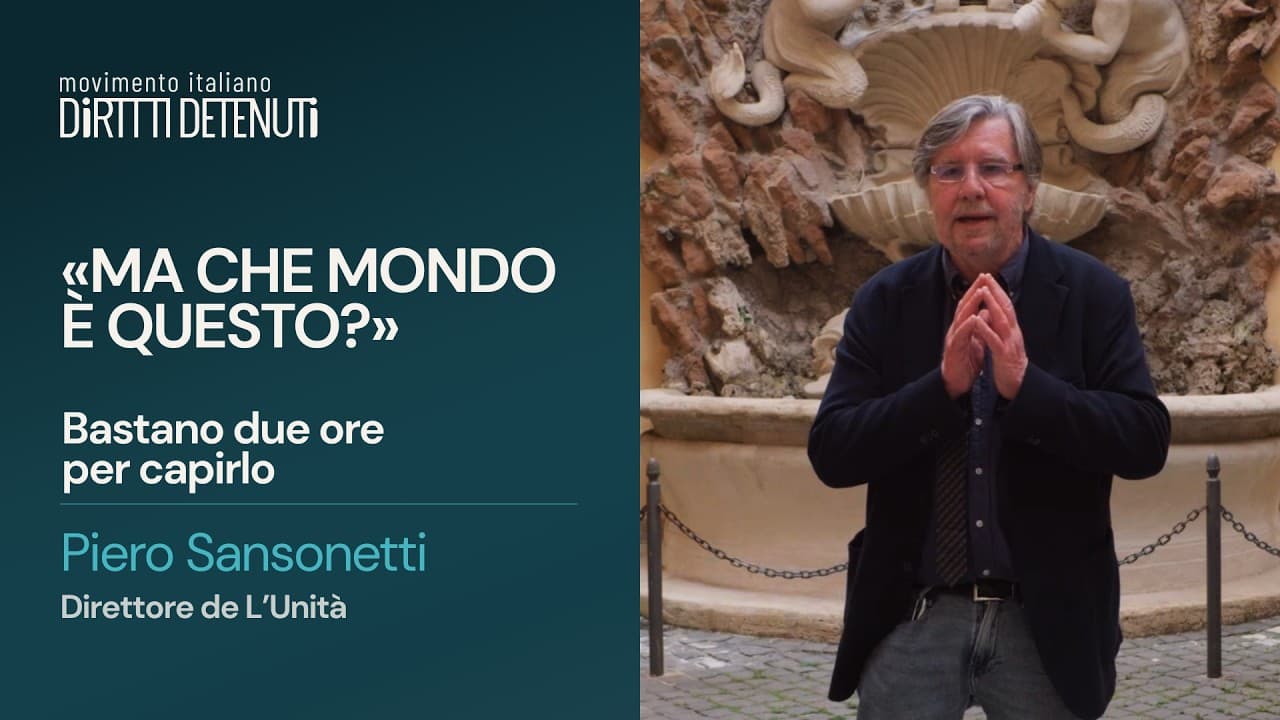
Piero Sansonetti reflects on the necessity to abolish prison, criticises social indifference and recalls the civic commitment of Marco Pannella.
The limits of battles over punishment: "no one talks about it"
Two prisons must be abolished. I say it in a clear-cut way.
The limits are that almost no one talks about it. That is the limit. In the matter of prison, almost no one talks about it.
Prison is a disgrace. It is an absolute disgrace in a modern, democratic and liberal society. It should not exist, it cannot exist. I
"Two hours are enough to understand it"
I have been there a few times, always accompanied by Nessuno Tocchi Caino.
If you spend two hours inside a prison, you see the cells. I was in Trani recently, you see the people in there, you talk with those people, but you say: "But what kind of world is this? But what kind of world is this?"
This is something intolerable: the existence of prison, the fact that some people decide that you are guilty, that you have committed a crime, that now I take away your freedom and I lock you in a cage. I lock you in a cage.
It is stuff from 400 years ago, it is the Middle Ages. Prisons must be abolished. I say it clearly, prisons must be abolished.
Is a society without penal institutions imaginable?
A free society where people are free, naturally.
Of course, if there is someone who commits a massacre, it will be necessary to put him in safety for some days, for some months, maybe even for some years, he will need to be treated.
Now we are talking about the Modena massacre, he says "But he was unbalanced, guys". But according to you, someone who commits a massacre is not unbalanced? Anyone who kills is unbalanced and must be held, treated, cared for. We need to see how to bring him back into society. It is evident, but apart from the fact that very rarely is there certainty that the crime has really been committed, we never really know if someone is guilty or innocent, but how do we allow ourselves to lock him inside a
Is it possible to abolish prison?
In the society I see today, unfortunately I fear that we must resign ourselves, but resign ourselves as Pannella resigned himself and did not resign himself. If a battle was just, he fought it. It could last a lifetime, but he fought it.
Let us fight the battle to abolish prisons, yes, one can win or one can lose. Often one loses, but it is not certain, sometimes one wins and even Pannella sometimes won his battles. He even won some that he lost. Battles are won or lost. It is very important to win them, but losing them is also important.
The memory of Marco Pannella and of the Radical Party
An extremely difficult question: but how can one have only a single memory of Marco? I have so many.
Personally, we only got to know each other in the last years of his life, but I have been following him since I was a boy and he was a young rebel. We can say that he was a rebel, Pannella, because this term is not used much, but he really was a rebel.
He is someone who blew everything up in Italian politics since he was young, I am talking about the end of the '60s. He always had the idea that politics was not a way to follow power or to chase power, but on the contrary was a way to blow up power. And his enemy, his enemy was power, it was not the trophy to be reached. And this has always been the case, even since, I believe, in the mid-'50s, when the old Radical Party, the one of Panunzio, the one of Ernesto Rossi, was falling apart then, as often happens to the radicals, in a somewhat quarrelsome way.
And once Fabrizio Cicchitto told me that, he was a boy, but he took part in the meetings, that after this furious meeting in which papers flew, almost punches flew, and the story of that first old Radical Party, the one of the Carandinis, Scalfari was there too, I believe, ended, and he waited for everyone to leave, then took the archive, took it away and founded the new radical party. And so this story of his begins, which is the story of someone who always blows up the table. That is what he knew how to do.
He did it with divorce, he did it with abortion, he did it on civil rights, he did it on life imprisonment, he did it on prisons, he did it on non-violence, he did it on world hunger, he fought a number of battles that we cannot even imagine.
He was a gentleman, he was a person, he fought more battles than entire great
What it covers
Laws cited
- Art. 27 Constitution — It establishes that criminal responsibility is personal and that punishments must aim at the rehabilitation of the convicted person.
Keywords
- abolition of prison
- prisoners' rights
- Marco Pannella
- Radical Party
- custodial sentence
- free society
- civil battles
Who speaks
Piero Sansonetti
The right at stake: compensation for overcrowding
More videos on this right
Giachetti: “Prisons are pigsties”
Roberto Giachetti