Prison reflects society: a humane and re-educational approach is needed, overcoming prejudices and promoting cultural and legislative change.
The question about the sentence
Once, one of my professors said to the whole class: "Do an experiment, think about what punishment you would give for the most serious crime you can imagine."
The first experience in prison
The first time I entered prison I entered in Rome, at Regina Coeli, and it was very impactful because I had already been interested in the subject for years. It was a topic that was close to my heart, but for the first time I could actually see it from the inside, because the big issue in the end is that anyone who does not go inside prison cannot see it, cannot really get a hands-on sense of what it is, what life is like inside.
The thing that struck me the most were immediately the stories of the people who for very different reasons, for very different issues were inside the institution, living in inhuman conditions, really too many, in a single cell with very few activities and opportunities for rehabilitation, so I was very struck right away by the stories of those people who for different reasons were there and yet did not see an alternative and a way to come out better.
Speaking of seeing, prison is often hidden from the gaze of citizens, you as a political initiative worked on a campaign that was called precisely "You Must See". What was it about? We tried over several years to enter prison not only with our militants, radical leaders of +Europa who are already in some way sensitive to the issue, we also tried to broaden, to make the subject known and above all to let citizens see with their own eyes what a prison is like from the inside.
Any citizen who in a form we filled out said they were interested, wanted to have this experience, we gave them the opportunity to enter prison with us, obviously guided, meeting the director, the female director of the prison, following a path, but to see with their own eyes.
And this, those who had this experience with us, told us was something very impactful because you really discover what the subject is, what life is like in prison; even though it is obviously a somewhat sugar-coated snapshot, it is very different compared to only hearing about it.
And what was the reaction of the people who entered with you? They were all very struck because they did not expect - even though the stories about prison are certainly not idyllic - they did not expect such a situation, especially in some institutions where perhaps there was not even a toilet inside the cells, where those who were inside - the prisoners - told us that they had very few educational activities or even the account from the prison police who are often understaffed, who also found it very hard to live inside this ecosystem.
So all the various testimonies, even those of some directors, perhaps particularly enlightened, who would like to do more, fix some situations and try to create workshops, initiatives, even more work-related paths, but who perhaps struggled due to the few resources, due to the many difficulties that exist.
The Movimento Italiano Diritti Detenuti I believe goes in the direction we have talked about today as well, in the right direction, that of trying precisely to change the narrative. The experiences of those who have been in prison are also needed, of those who have lived it from all the different points of view, directors, former directors, officers, former prisoners, who can tell us in the first person what prison is today and why through some cultural and also political changes of legislative measures, it would be possible with a few moves to greatly improve the life of those who are today inside those institutions and more generally to have a humane and functional approach.
Prison as a mirror of society
It is always said, in a banal way, but it is true, prison really is the mirror of the society in which one lives and also of the politics of a country. Having a more effective, more useful, different human approach to prison means changing the very narrative mentality of an entire country.
Once a professor of mine said to the whole class, "Do an experiment, think about what sentence you would give for the most serious crime you can imagine." And the whole class started thinking.
Well, I believe that even in the face of the most serious crime we can imagine, the most difficult to accept, to which we would want to respond viscerally, we would want to respond "an eye for an eye" to those who commit that crime. Instead, let us imagine what sentence we imagine.
For me there are only two possible answers, one – which for me is unacceptable – which is the death penalty. I do not want to see that person anymore: the death penalty. We fight against this vision, we consider it wrong, but logically it is an answer, obviously not conceivable for us; and the other answer is if instead we think that that prisoner, that person sooner or later will have to leave prison and so we must ensure that they have a just sentence, that they have the lowest possible sentence so that they can leave changed, not reoffending.
This is the approach that I believe we should carry forward, trying to change a narrative that perhaps is a little more complex, a little more difficult compared to shouting that we must throw in jail anyone who has committed a crime or anyone who perhaps still has to undergo a trial.
The trial is not even over, but already they are a criminal for the press, for social media and for politics.
What it covers
Laws cited
- Art. 27 Constitution — It establishes that criminal responsibility is personal, the punishment cannot consist of treatments contrary to the sense of humanity and must aim at the re-education of the convicted person.
Keywords
- prison
- sentence
- rehabilitation
- prisoners' rights
- detention conditions
- society
- narration
- death penalty
Who speaks
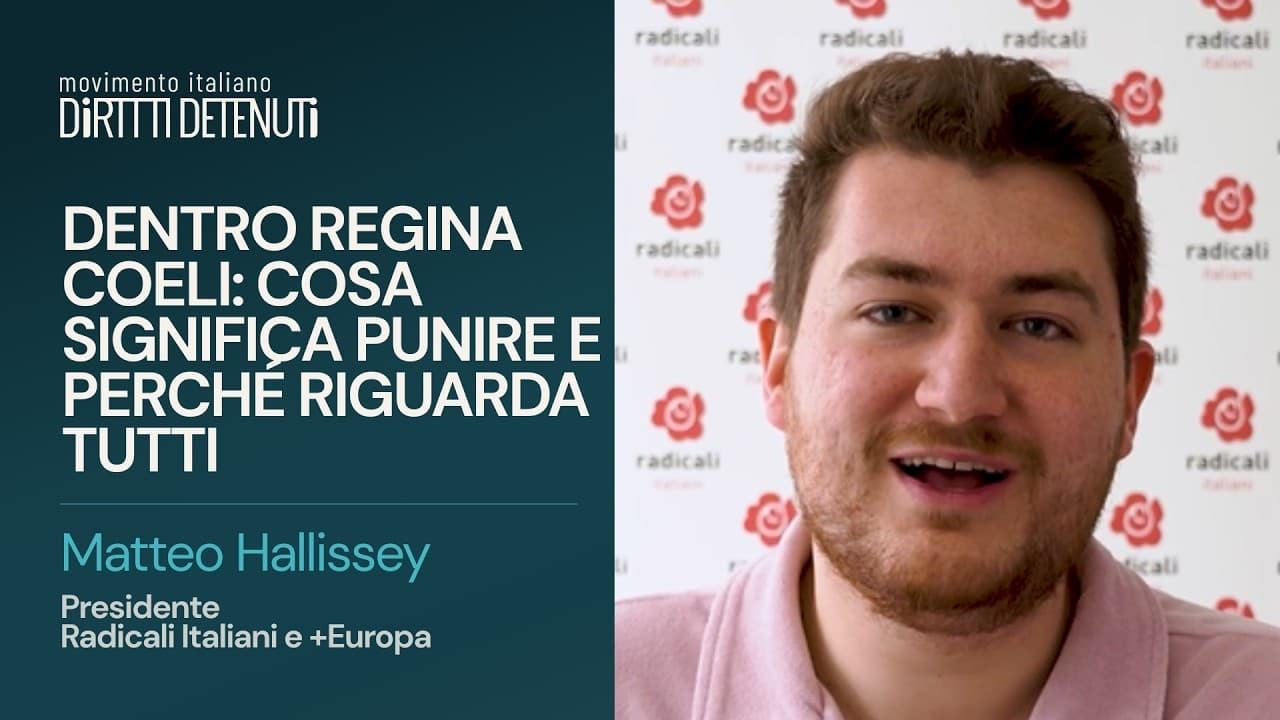
Matteo Hallissey
The right at stake: compensation for overcrowding
More videos on this right
Giachetti: “Prisons are pigsties”
Roberto Giachetti