Compensation for overcrowding
Ep. 03 · Care is a gamble | Nicola Cocco
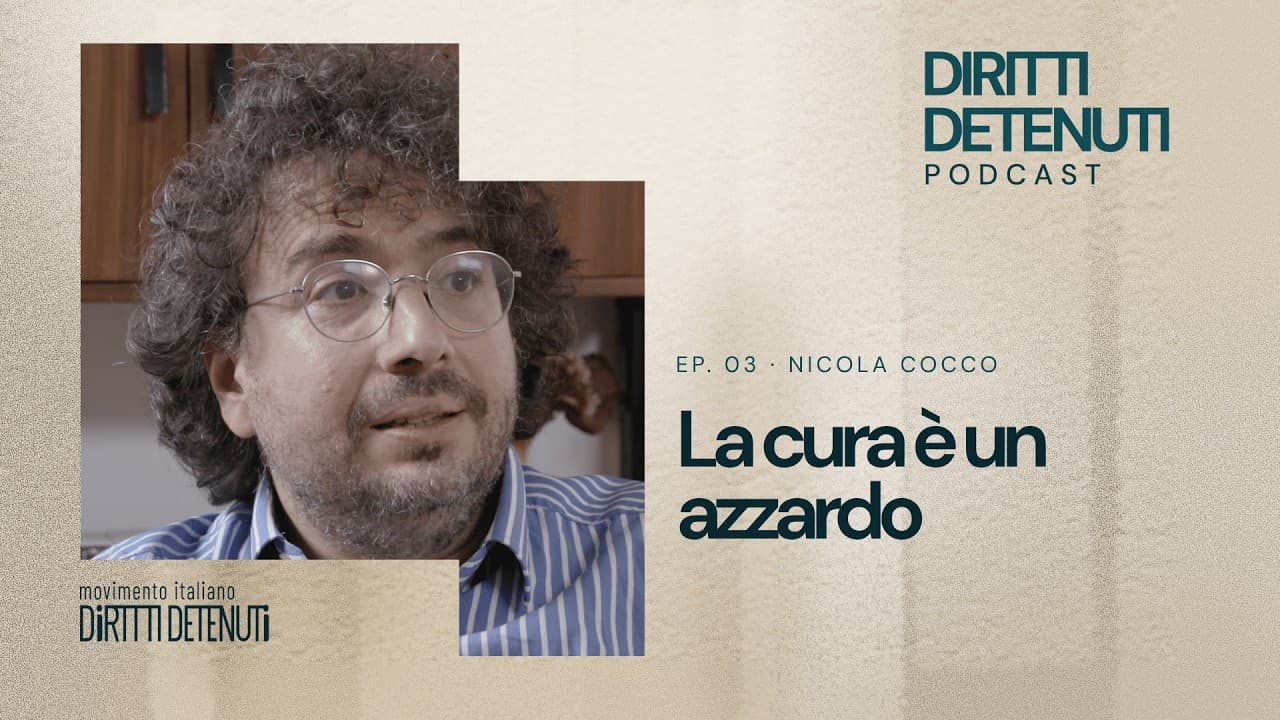
Nicola Cocco recounts his experience as a doctor in prison, among suffering, dehumanisation, pathologies and structural limits of detention.
Introduction
I have always felt like a guest inside prison because it is a place that was created by men to make other men suffer who have made other men suffer and therefore in that context care becomes almost a...
What is the purpose of prison? What effects does it have on the lives of those who inhabit it? On the detained people, on those who work there and on all of us? Every answer begins with a story. A door closes, but what changes inside? What remains outside and what could go differently.
We will walk through the corridors of the sections, enter the cells, visit the surgery of a prison doctor, go to an interview with the lawyer, we will take with us the keys that lock and unlock the reinforced doors and then it will be up to each person to answer the question: "What is the purpose of prison? This is Diritti Detenuti." Today it is Nicola Cocco.
Prison, a humanitarian zone
Nicola Cocco, welcome and thank you for being here.
Thank you.
You are an infectious disease doctor. Before telling us how you encountered prison in your life, I wanted to ask you about your background.
I basically come from a background as a humanitarian doctor. I have worked with various NGOs, with the World Health Organization. The bulk of it was missions carried out with Médecins Sans Frontières in various countries of sub-Saharan Africa and so the context is that of humanitarian work and at a certain point you return to Italy and you encounter prison medicine and prison itself.
I was forced to return to Italy because my wife insisted that I come back and the encounter with prison happened because one of the heads of prison medicine in the Lombardy Region was looking for someone with a CV that had an attention to the humanitarian aspect and I think this is something to be emphasised precisely because inside prison I found the same dynamics, the same problems that characterise humanitarian contexts.
So perhaps it is worth specifying what we are talking about, because often when one hears humanitarian doctor one thinks a bit of a missionary doctor, of volunteering, right? In reality, the term humanitarian indicates an attention that the doctor gives to the body, to life, to people, to their stories, to their communities, regardless of the social determinants that are around. What interests me is that I must preserve that body, that person, that life outside of those determinants and I must try to intervene on those determinants.
Working for Médecins Sans Frontières, those determinants can be a war, an armed militia or whatever. In prison it is prison itself, the social determinant that goes on to condition the state of health of that body, of that life, of that.
And you were saying that prison can be considered in many respects, indeed, a humanitarian zone, an emergency zone. What are these aspects that unite the two experiences you have had? What kind of place is prison for a doctor whose aim is the care, isn’t it, of people?
It is a place that in my opinion is characterised by three aspects: the aspect of being considered inevitable, a social necessity that therefore as such looms over our societies; on the other hand, it is often perceived as an opportunity and this clearly is also part of the constitutional dictate, so as something that can really change people who have made mistakes; and on the other hand it is a place of extreme suffering which clearly as a doctor is the first thing I found and that a doctor should find. The problem is that the other two aspects are often then taken up by the discourse of security and completely overshadow that of suffering which is then the one most linked to the individuality of the detained person.
Therefore, the problem that makes prison a humanitarian place is that the priority of prison still today remains that on the one hand of justice or rather of revenge. Because justice is something different from wanting to see the suffering of the person who made you suffer.
And this idea of security is always a priority compared to that of respecting the rights of that person who remains a person who therefore remains the holder of rights and even of dignity.
I feel obliged to recall, well, this discrepancy is the source on the one hand of individual suffering and on the other of illness. This is the issue of the pathogenicity of prison itself which does not create illness in itself, it creates it from the moment it is a place where people find themselves deprived of liberty following the offence, following the trials or whatever, but that aspect of deprivation of liberty overshadows the aspect of respect for rights and here illness then intervenes. So,
Being a doctor in prison
prison is indeed a closed place, a hermetic place and therefore often hidden from the eyes of citizens and also from, let's say, the democratic control of the guarantee of rights. And so, since you worked inside for years, I would like you to tell us a bit concretely what your work was like.
You spoke about this health-related aim that sometimes, often, overshadows all the other needs of detained people. For example, what does it mean to work side by side with prison officers? A police force, how does one practise medicine in a prison, even precisely in its...
I'll start from the beginning of your question because you referred to a figure that is often used precisely regarding the control of infectious diseases in prison. That is, the prison as a hermetically closed entity does not actually exist. And it is often discussed as a porous reality that transmits, that lets in viruses, germs, then there was Covid. It's a pity that this does not apply to rights, it does not apply to civil society. So this porosity is only for germs sometimes.
Instead, what decades, among other things, of testimonies and studies have shown is that if you let civil society into prison, you let people out from inside prison, not necessarily for activities that then end up in the newspapers, like the Teatro della Fortezza, just to be clear, but also for small things that still maintain a link with society for these people, detained people benefit from it.
In any case, and always, every contact with the outside is a contact that saves the people who are inside. Why is this? Because daily life inside prison, as you described very well, in your work, is a reality that basically creates a bubble for the people who are inside and this also concerns respect for the right to health.
I worked as a specialist inside the prison. Simply even from that perspective you could see something abnormal, in the sense that I was in the prison clinics and the detainees, the detained people, were brought by the prison police, so there was this sort of selection based on the problems.
I often then actually asked to go into the common areas, in the section, in the cells, also because the infectious disease doctor needs to see the context or should need, every doctor actually, to understand what is the humidity that causes diseases, to quote Bert Brecht. And the problem is that very often doctors do not do this, they stay in the clinics, they stay in the emergency room and people are therefore only brought when a health problem reaches its acme, to use a clinical term, when it is already very advanced.
Daily life, therefore, is almost always made up of emergencies, so you have the person who comes to you with a new diagnosis of HV, for example, in an advanced state. I'm talking to you about HV which nowadays also has its own possibility of being taken care of. But I could talk to you, for example, about tumours.
Most of the people I followed with neoplastic problems arrived at the diagnosis late and so this daily life inevitably is made up of a feeling of being a guest. Here, I as a doctor have always felt like a guest inside the prison because it is a place that was created by men to make other men suffer who made other men suffer and so in that context care almost becomes a gamble.
It is out of place. It is almost out of place, isn't it? And in fact often my request to, as they say, go and fetch the detainee as if he were a parcel, isn't it? But actually going to call him to say, look, the infectious disease doctor is looking for you is sometimes a burden for...
The prison officers
for the prison police. Then I tell you the prison police, the prison police is one of the key elements of life inside the prison.
I am not someone who, let's say, tends to criminalise the prison police. I am convinced that there is a structural problem with the law enforcement agencies in the country, but specifically with this one, erm, the prison police, since it leaves a lot to the individual free will the way of managing the detained people.
I can give you some examples. That is, the central point is that the listening ability of a prison officer, who is a figure in the life of detained people, since Italian prisons are thought of as pl... anything but panopticon, they are thought of as places where basically the prisoner-policeman relationship must be, I am not saying one to one but one to two.
And this clearly leads you to say: this person who has to stay 24 hours a day, their job is basically inside a context of deprivation of liberty, what training characteristics must they have? What characteristics also, I would say, of empathy must they have besides the fact of knowing how to manage a security emergency?
And unfortunately this is left to individuality. I have met incredible prison police staff who acted as psychologists, as social workers and in some cases also as cultural mediators with some people who spoke very strong dialects with whom I could not speak and then I have had to deal with monsters, that is, people.
What is the monster? The monster is that person who no longer sees the humanity in the other and shows... I have not seen and would never say that they are rotten apples. They are people who have at least not been selected in the training process of the police because if you do not see in the detained person another yourself, do not see another person, you have such power over them that sooner or later that power becomes violence.
Of course. And this is dramatic because there is not a structural framework that can protect the police themselves from becoming violent.
"You're pretending": simulation and self-harm
With respect to this role of mediation. In my research, also in the field of care within prisons, I have often collected this account, that is, detained persons who complain of a pain and are told: "You are pretending, you are lying, you are faking." Because there is the idea that the detainee is lying and has a plan to obtain something that involves, precisely, the invention of illnesses, pains.
Eh, Because there is this suspicion and what consequences does it have on, precisely, the possibility of taking charge of an illness, a pain at the moment when it is still treatable? In a certain way? The suspicion exists because basically the... But this does not concern only the prison police, it also concerns the healthcare staff, very often.
Eh, It exists because you are not able to humanise the detained person and you basically see them as a person who wants to trick you. Ok? This is, unfortunately, part of the prison game which among the rules, if you allow me, also has that of wanting to use one's own condition instrumentally to obtain an improvement of one's living conditions.
Because no one Also because the reward system often works like this: you do this, I reward you like that and so in some way it is also a training to find the right expedient to get to the... You know, paradoxically if the illness becomes a reward, if I can use it to improve a situation which for me is in any case one of suffering, attention here we are not talking about the tricks of clever people who want to obtain, of people who have actual suffering.
So in this game there is the dehumanisation by the staff who have the power, including the doctors, eh, who have the power to make decisions that charact... including judges, police, doctors, magistrates decide about your life.
And you have to make a little request also, apart from the fact that you have to make a little request just to buy a pair of underpants, as you well know. Imagine on health issues.
The issue of simulation, in reality prison medicine has dismantled it for decades, taking the example of suicide for instrumental purposes. What does prison medicine say? It says that the spectrum of self-harm and the self-harming act and suicide is not, let's say, continuous, it goes in jumps and if a person today has made a suicide attempt, a simulated suicide to obtain something, nothing tells you that tomorrow that person will not really commit suicide.
And these, this science is data because there have been collections of series in which people who had accumulated demonstrative acts one day killed themselves.
Look, to describe self-harm I always use the words of Luigi Manconi when he spoke of it as a language, not an illness, a language written on one's own body by people who have no other languages to use, who are not listened to.
And when you have only your body what must you do? Yes, he said the body becomes the paper on which to write.
Exactly, the body becomes the paper on which to write. It is up to us to know how to read, in reality it is up to us to know how to listen and perhaps not to get to the point that they use the body to express certain requests.
Prison-related illness
Let us talk about bodies. Prison, detention, the deprivation of liberty does something to bodies, it affects the senses, indeed. It is something pathogenic. What are the effects? The fact that all five senses are altered, the fact that you begin to have recurring sounds linked, for example, to the clic clank clic clank clic clank of the locks or that you lose the perception of the weight of metal cutlery because for years you will use only plastic cutlery, or that you have levels of vitamin D and therefore of the health of your bones that will inevitably become pathological because you are no longer in contact with sunlight for, eh, several hours a day.
And all this has been described. I call it prison disease, bar sickness. These are all, eh, bodily reactions of adaptation to the deprivation of liberty. But the most serious aspect from the, let us say, holistic point of view of the person, as far as I am concerned, is an alteration of the perception of the self. The detained person at a certain point simply becomes a part of the prison, eh, is no longer able to recognise an individuality that is not within the dynamics of the prison and this is dramatic. This has effects on the mental health of people. That is why I always say, based above all on a study that Sir Marmot did on the anset, who said mental health and prison, detention are a hanepy coccurrence, that is, an unhappy combination. There cannot be a detention that is not psychopathogenic.
Psychiatrists know this very well, those who work inside the prison, since detention in itself is a very strong social determinant of mental pathology and this also explains the use that is made of psychopharmacological therapy.
And while you were speaking this thing came to my mind that struck me a lot, that a prison officer told me: and a detainee one day comes and asks him please if he could have a photo of and the officer says to him "But why, for your family, for your wife?" He says no, it is to see myself, it is to see myself entirely. No, there are no mirrors. If there are, small plastic ones, deforming, speaking of lack of perception of oneself and of the existential suffering that this entails, no?
Because in any case at a certain point this institution that locks you up, eh, ends up swallowing you, no? And you no longer know exactly where you begin and it ends. And indeed this has enormous repercussions on mental health. Here, there is often talk of
Dying of prison
prison in the newspapers, on the news, saying "The prisons are full, they are overcrowded and then this is the suicide count." And by now perhaps people have also become accustomed to these numbers, 70 80 83. If I think of 83 people in a line and I think that that is the number of people who in a year take their own lives, if we then add the prison officers as well there are even more because of prison, they die of prison, in short, it makes an impression on me.
And what also happens concretely if you have any memories? To give you some examples of how the body, in fact, then becomes the main element, I will tell you about an Egyptian person who had entered, among other things, prison only a few months before in a remand prison in Milan with who had completely closed himself off. A person of Egyptian origin, he lay on his bunk and did not speak to anyone anymore.
There are these cases, right, of people who wall themselves in, they are not on schedule. This one even did not wash, ate just the minimum to sustain himself, did not speak with the other cellmates, did not speak with the officers, did not even speak with the cultural mediators, he did not even speak with me. Complete mutism, complete which in reality was a refusal of contact with one day, one night they hear him screaming and crying. He had practically never moved from the bunk.
He was crying in pain, screaming, they take him to A&E in hospital and it turns out he had a fracture of the head of the femur linked to an aseptic necrosis, so not a traumatic fracture, but an orthopaedic metabolic problem. Now I don't want to go into it, but basically it is something that who knows how long he had been having and that we did not intercept at all because he was not a contact person for his health, for his person and therefore avoided having any contact.
And this, for example, is a case for which I would not know how to find you a solution, that is, he did not express the symptom that he nevertheless felt. He only arrived when he had basically broken his femur and therefore had excruciating pain. Exactly. I could tell you about other types like this.
And then there is the whole discussion about the attempt to escape from the reality that prison represents. Because when you then realise that normal communication perhaps does not exist, the intermediaries, the police, the doctors, the educators do not work. I repeat, I am telling you about the critical issues, eh, there are positive examples, in short, but those are the good stories to which unfortunately I cannot contribute, that is, I do not tell you about the stories that go well because the prison institution already talks about them enough from that point of view.
When even that does not work, there is then the attempt to escape in the search, for example, either for medication or for illicit substances that circulate in prison, or, this is a case I am following right now, simply in getting high with the gas from the little stoves, that is, using the stoves to get dazed, they have gas stoves available to heat coffee or to heat up food.
Other great absurdities. Many people have died like this, eh, inside prison, that is, inhaling the gas, inhaling the gas. Yet it is not possible to provide electric stoves because there would be the risk that then, eh, they use the sockets to endanger the security of the prison.
Some people recently in Milan, eh, while getting high with this gas, inadvertently set themselves on fire because then one lit a cigarette because he was dazed and they set themselves, they set themselves on fire, we are following them now with crazy burns.
And what happened? But the news that reached me at the beginning where I work was that these two while protesting had set fire to the cell and had also set themselves on fire and it was absolutely not true.
So on the one hand there is always a narrative aimed at criminalising the detained people, on the other the attempts to escape, another dramatic example that occurred again in this remand prison in Milan towards the end of last year, since it is well known that there is a traffic of narcotic substances, including heroin inside the prisons, there have been two cases of death by overdose.
Inside San Vittore prison last year of boys who evidently were not used to taking heroin and the aspect that struck me most, beyond the tragedy obviously of the death of these two boys, another three ended up in A&E, eh the fact that even though there was naloxone, even though in theory the nursing staff is trained in case of opioid intoxication.
Nevertheless the people died, they did not manage to intervene in time or did not do so adequately. I do not know the details, but in fact and this is prison, that is, a place where paradoxically you also do prevention. I do HPV vaccines in prison, you see?
That is, crazy things are done, some graduate in law writing precisely about prison and then boys die of heroin.
And these are not paradoxes, they are the extreme consequences of a place that, I repeat myself on this, is not conceived to safeguard the individual, but to reassure the
The therapy trolley
these people, in the great suffering of daily prison life which precisely annuls the personality, therefore seek some kind of sedation.
It has often happened to me that detained people have told me about cellmates, precisely, who slept all day and all night, got up just to eat, like the case you were talking about. And that is perhaps the greatest failure, isn't it? Because, and it makes me reflect on the word arrest, doesn't it? Which also means to stop, to stop a person, the time of prison which precisely the Constitution says should be the time of re-education.
I too am very critical of that word, but the word even worse is re-education. Yes, because it implies a return to a norm which in my opinion is exactly what produces this marginality and these, in short, these consequences. But I was saying, if it should be the time of re-education, well, we are absolutely failing. If what people are looking for is to let that time pass with as little consciousness of it as possible, that is, I prefer to spend 2 years on the bunk stunned by psychotropic drugs and here I wanted to talk about this.
I wanted to ask you what is this therapy trolley, what is therapy in prison? Therapy is basically psychopharmacological therapy because it seems that it is the only medicine that exists in prison and this is a peculiarity that the data explain well.
If you think of Antigone's reports, the numbers for psychotropic drugs are almost always the same, that is, 40% of the detained population in Italy has at least one psychotropic drug in therapy compared to 10% with psychiatric diagnoses. What does this mean? That there is a 30% who do not take those psychotropic drugs to treat an illness, they take them for something else. And this something else is sedation.
So therapy, the therapy trolley is the instrument of sedation in prison, that is, a trolley that distributes medicines daily. Yes, this changes from prison to prison, but in the vast majority of prisons the nurses bring the medicines with this trolley.
Among other things, there is not, eh, how to say, a personalised distribution of medicines, is there? You go with the little cups that are on these trolleys. In the little cups is put the of various, you approach the blind and say Mohammed and you give him, Gennaro and you give him this. And clearly that is not a therapeutic act, that is the distribution of a medicine. It is a different thing.
If we consider that most of those medicines are sedatives, we understand that that is essentially the moment in which the prison is almost carrying out its organic function, because otherwise people protest, complain, have needs, don't they? Instead if they sleep, this is dramatic because the psychotropic drug in all places of detention, particularly in prison, but one could also talk about others, meets the needs of these three actors.
On the one hand the prison administration, doesn't it, which says anyway well, they are there quiet, they have a health need and I respond to them the police, because clearly intervening with a psychotropic drug is much better than intervening to sedate. I do not like to use the term with the truncheon because I have seen the wounds from truncheons and so the intervention of the truncheon does not please the police either, let us be clear about this.
Better the medicine also for the police and then the dramatic aspect is the one we referred to before that the request comes from the detained person himself who often tells you: look, several have told me: doc, I just want to wake up, I do not want to wake up here anymore, I want to wake up tomorrow not being here, a tomorrow when I am not here, so the more I sleep, the better.
And so you see therapies of eh 60 drops of voluma, for example, which are doses that if you and I take them. I am not saying that they could even have serious, eh, risks and look this is a reality that also concerns juvenile prisons at this moment.
One of the aspects that had shocked me about the daily life of the prison, eh, of Beccaria in Milan was the fact that the medical office had basically become a drug dealing square because when they knew you were there as a doctor, that the doctor was there, the boys would come to ask for medicines.
Who is in prison
Nicola, earlier you were talking about drug addiction, substances that still enter and circulate in prison. I wanted to ask you a bit: who is in prison, who are these people who are detained? They are the people we do not want to see in society.
Now you mentioned drug addiction, we need to consider that 25% of the people who are inside... one in four of the people who are in Italian prisons has a drug addiction problem, which is a health problem that should be managed in a health context.
We always talk about percentages because as a doctor they help me a bit to have some benchmarks. Foreigners, how many are foreigners? They are 32% of the prison population. One third. In the general population, let us remember that people of foreign origin are 9% and are decreasing because foreign people are leaving Italy.
So this discrepancy, for example, tells us how the use of the detention tool is greater for foreign people. Then clearly some political leaders will tell you: "No, it is because foreigners commit more crimes." But this is not a genetic flaw, but is linked to social conditions that lead to this disparity.
They are almost all men, there is a form of patriarchy, isn’t there? This is the stronghold of patriarchy, prison, isn’t it? Men who make others suffer, men who have made others suffer, isn’t it? Eh, and yet there is a 4% who are women and who find themselves in a completely male context.
I always say that some of the things I have learnt the most from have been meetings with groups of detained women, for example to talk about the prevention of diseases related to the papilloma virus, because then in prisons very targeted interventions are carried out very well. So I would go, I would give my nice long speech about the importance of preventing the papilloma virus, of getting vaccinated.
When I left space for questions, usually I speak for 10 minutes then everyone says to me: "Yes, all very nice, but we do not have a bidet." Yes, all very nice, but we do not even have the possibility to have sanitary pads from a health point of view. You understand that you need to know how to identify what the real needs are and today we do not know how to do this, even though health inside prison is managed by the national health system, but then you bring out the priorities if you talk to people.
So young men who are actually ageing because, for example, now more than 30% of the people in prison, especially those of Italian origin, are over 60 years old and prison is absolutely not equipped to have elderly people.
I know of wards, eh, in some prisons, in some prisons that are basically detention geriatric wards and this is dramatic.
In the sense, is this the population you find yourself facing inside prison?
Mothers and children in prison
A very specific discussion could be had about pregnant women and those who have children under one year old, because the penal code provided until 2 years ago for the postponement of sentence for these people.
What happened? You could go through the whole story, but in reality this is a story that originates from an investigation by Valerio Staffelli of Striscia la Notizia.
Obviously, to make their programme he chased after the young Roma girls who, I would like to underline, are girls of 17, 18, 19 years old who were pickpocketing in the Milan underground. Some of these were pregnant and what was the message that was conveyed? Let us remember, it was that specific programme: the Roma girls are used by the Roma community because if they are pregnant they do not go to prison because there is the postponement of the sentence.
What happened? This then we are talking about 2021-2022. What happened was that the Milan Prosecutor's Office was inundated with phone calls from Milanese people saying: it is a disgrace, these people steal our wallets in the underground and then do not go to prison because they send the girls who are pregnant.
At the time the prosecutor issued a specific circular in which it said: the supervisory judge is not obliged in Milan, only in Milan, is not obliged to postpone the sentence. Ok?
So already that summer the prisons of Milan filled up with girls of 18, 19, 20, 22 years old who were pregnant.
One thing that Valerio Staffelli did not talk about, and there is the news, is that that summer a woman gave birth to a child at San Vittore, inside the prisons, inside the cells of San Vittore, and during the transfer to the hospital the guards the child died.
These are realities that are then not talked about, but on which all the propaganda was built that led to that rule of the 2024 security package where this postponement of sentence was removed from the penal code throughout the country.
In fact now if one looks at the data from the Antico report one says: "How come the number of children inside the prisons has increased? Which is that thing, right? A bit tear-jerking that often makes one say 'But there should not be children inside the prisons'." And of course, because people give birth while they are detained, since the government has decided to use this propagandistic rule to show that something is being done against the pickpockets.
Of course. There is also all this making laws starting from news stories, right? Starting from media issues.
Listen, yes. The children in prison now, from 0 to 3 years old, are 30.
And even there I can just imagine, it is quite a large class of children all together.
Caring without understanding each other
prisoners. Earlier you were talking about the therapeutic relationship, right? And about communication and I wanted to go back for a moment to the issue of the 32% of foreign people, indeed, the basis of the therapeutic relationship between doctor and patient is communication, right? It is listening to the patient. How can you treat? That is, if you can also tell me about your concrete experience as a doctor and in a prison that has to deal with people coming from different parts of the world who perhaps do not speak Italian or speak it barely and need something but do not have a way to communicate.
Look, I'll tell you about a case eh that made me suffer a lot and that happened precisely at San Vittore, where I was following a Chinese boy, a boy of 22 23 years old who did not speak Italian and to whom I had to communicate an HIV positive status that he did not know about and so I would have had to explain to him that basically his life was changing without being dramatic, but simply he had to take medication, have check-ups and then, among other things, he also had to treat a sexually transmitted disease that I had detected.
The problem is that I would only have had cultural mediation a week later and so eh the meeting I had with him was basically useless because I could not talk to him. I clearly did not show him the papers also so as not to create fears and so on.
The dramatic aspect is that two days later I see the same person again, eh, in tears, eh, hugged, among other things he was being held by a prison police officer because he had been beaten eh in the section, probably because he was homosexual. In short, he was a person who needed to be protected and was not protected and so the problem of HIV had become extremely secondary.
And so I insisted on having mediation that very day and it turned out that this person had a history of violence at the base which then resulted in that crying fit he had because they had, they had split his head open. I met him in the emergency room and HIV was the least of his problems, but there had been no possibility to talk because linguistic mediation is also a challenge, despite the commitment that some organisations, for example in Milan, cultural mediation is done by associations, it is not provided directly by the State and this however is a bias because you have to keep up with the timing of the... Of course. It becomes a matter of luck that sometimes it is there. Sometimes, and even worse, it is at the discretion of the doctor in the health field, because not everyone calls for it.
Another doctor perhaps would have said to him, "Listen, there is HIV positivity, from tomorrow I will give you this medicine" and it happens. I assure you I do not want to say it is the norm, but it often happens.
No one would have investigated with a linguistic cultural mediator that moment in the emergency room when this person was there with his face full of blood and tears and to understand what had happened, how that violence had come about and this is a problem of the prison which gives you the medicines for HIV, but is not able to help you with the other aspects of your life.
Prison is the cell.
I would like to ask you something about the physical spaces because what is the clinic, the infirmary like, I don't know what the precise name is, of a prison doctor.
Let's clarify that the prison is characterised, it's a bit like "A Tale of Two Cities", isn't it, by Dickens. There are two different worlds in prison. One part is that of those who work in the prison, so the administration and then the healthcare part, and then there are the cells.
These two worlds have an invisible boundary of different conditions, because it has often happened, at least it has happened to me to have detained people who made a request to have an infectious diseases visit, even just to come and stay half an hour at... And this says a lot about that division, because instead the cells are pathogenic places, places of degradation, often characterised not only by the cramped spaces which are structurally intended or not modified because it is part of the punishment in the view of those who see, isn't it, punishment, revenge, in prison.
Let us remember that the deprivation of liberty is the punishment, not the fact of living that deprivation of liberty in shit, that is an accessory punishment and which is structural, but which is created by how the... Yes, it is not a mistake. If I think that overcrowding in some prisons, in some remand prisons, has resulted in having three rows of bunk beds, in summer, then it is clear that it becomes a slaughterhouse and what do you want to do in a slaughterhouse?
And this is the reality, so the place reflects the pathogenicity. The part that should guarantee care is simply a more aseptic place where the staff work in more dignified conditions.
Yes, in fact this division, that you mention is also the one that often gives a somewhat misleading idea of the prison to those who enter also like me, isn't it? As a volunteer, as a researcher, as a journalist.
People enter the school, the theatre, the library and it all seems, all things considered, often anyway the prison is the cell. The prison is the cell. The rest is superstructure, but the prison is the cell.
And let us remember that the cells in Italy and in almost 60% of cases, apart from not having showers, but that is, but they have the toilets near the beds, often separated by a little stove, all there. So basically the organic functions, in one single place: eating, sleeping, shitting, it's all there.
Exactly. Mag Yes, yes. Nicola, in the light of all
Towards an abolitionist medicine
these things that we have said to each other and that you have told us, how do you see the future? What will be the future of prison? The future of justice? Is this justice? How can we rethink it?
So, very briefly I will tell you that I see a future in which things will go much worse and then begin to... I fear that the social moment in which we find ourselves still asks for much revenge, still asks for much racism towards foreign people and still asks not to recognise human beings in the people who are placed in detention contexts.
But this thing will change, sooner or later it will have to change, and the change will come when the interventions to improve situations will not be like technical interventions of embellishment, like saying let's put an operating room in prisons or let's put more doctors in prisons, but the situation will really improve when it will be possible to implement what is also called at the international level abolition medicine, that is, an abolitionist medicine that does not utopistically ask for closure, but of prisons we are well aware that it would be an ahistorical request, but at least asks to put at the centre the intervention on those social determinants, including racism, including the will to have revenge and not justice, that improve the living conditions of people: more houses, more schools, more health, will certainly mean less prison. But, here, we must begin to reason in that abolitionist perspective and not in a reality that always wants people more and more protected from places in which people are placed.
Thank you, thank you very much.
Thank you. You have listened to Diritti detenuti, a podcast of the Italian movement Diritti detenuti. The interviews are conducted by me, Isabella De Silvestro. The editorial production is by Marina Beraha. The direction is by Stefano De Felici. The audio and video recordings are curated by Am TV.
What it covers
Laws cited
- Art. 27 Constitution — The punishment must aim at the rehabilitation of the convicted person and cannot consist of treatments contrary to the sense of humanity.
- Criminal Code, postponement of the sentence for mothers with small children (art. 146 c.p. and art. 147 c.p.) — It provided for the possibility of deferring the sentence for pregnant women or women with small children, a rule modified by the 'security package' 2024.
Keywords
- prison
- human rights
- mental health
- prison medicine
- suffering
- detention
- penitentiary police
- rehabilitation