Compensation for overcrowding
Ep. 02 · The keys on the belt | Gioacchino Veneziano
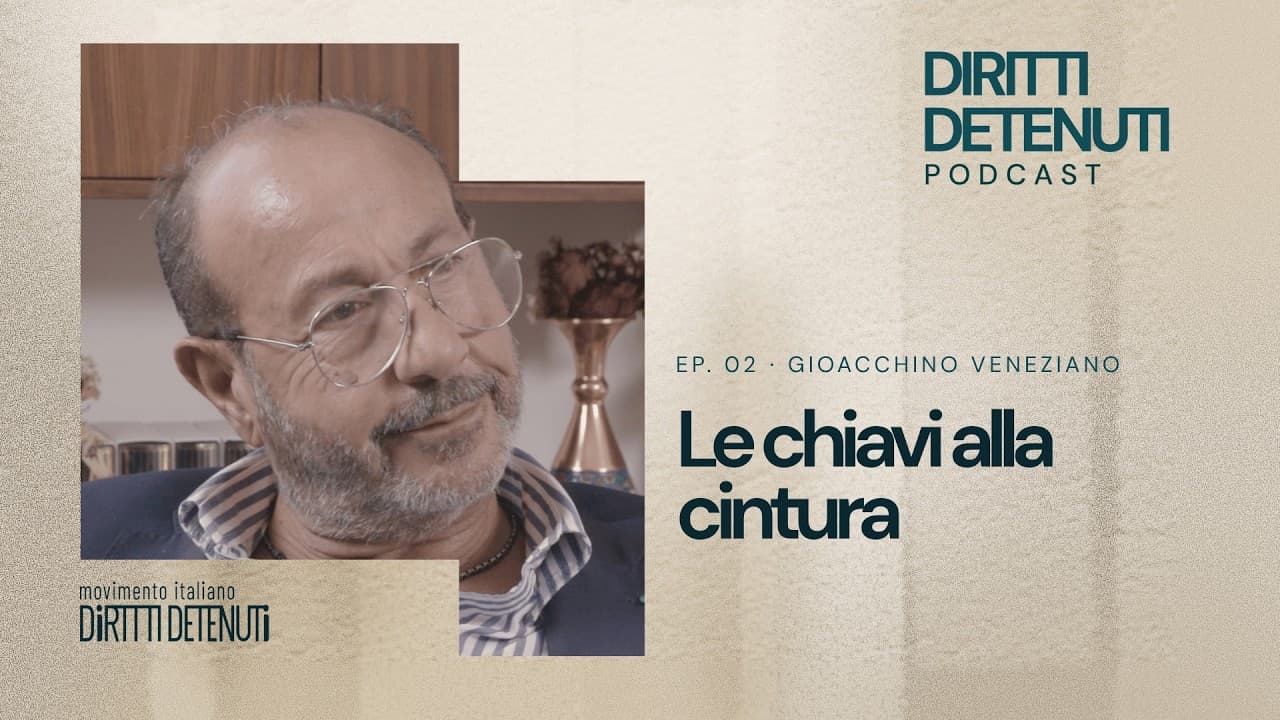
Gioacchino Veneziano recounts his experience in the prison police, among difficulties, changes and reflections on the meaning of prison.
Introduction
In the end you realise that when they are in packs the relationship is different because you have to defend yourself, but one by one you see the fragility of the being.
What is the purpose of prison? What effects does it have on the lives of those who inhabit it? On detained people, on those who work there and on all of us? Every answer begins with a story.
A door closes, but what changes inside? What remains outside? And what could go.
We will walk through the corridors of the sections, enter the cells, visit the surgery of a prison doctor, go to an interview with the lawyer, we will take with us the keys that lock and unlock the reinforced doors and then it will be up to each person to answer the question: "What is the purpose of prison?"
This is Diritti detenuti.
A prison under the house
Today's guest is Gioacchino Veneziano. Gioacchino Veneziano, welcome and thank you for being here.
Thank you. And to start, I would like to ask you how you came to know prison, how you arrived at prison.
I was born in Erice. Erice is a mountain locality in the province of Trapani, but there is the hamlet of the San Giuliano district. In '65 a prison was built, so I lived about, as the crow flies, about 200 m away, also because as a boy there weren't all these buildings that have now sprung up, so I could see the prison from the balcony, I could see it, I saw these men in uniform and as a boy I thought the prison was only these four men, then inside I didn't know what was there because the perimeter walls, I didn't know what was inside. I knew there were prisoners, but I didn't know how it was structured.
And where did you see these men? Right on the wall. I saw them on the wall, I saw them all day and I also heard them at night because at night with the changing of the guard, of the shift, as it is called in jargon, there was the so-called 'altolaià', password and the counter-password. So at night in summer, especially when we slept with the windows open, I heard all the procedures of the changing of the sentinels, of these men in uniform, of the then custodial agents and today police.
And do you remember, let's say, what you thought, that is, what were a bit your impressions of this image of the prison?
As a boy, as a boy I had a nice motorbike. My father had given me a nice motorbike and behind that prison, because I repeat it was an area that was not urbanised at the time and there were uncultivated lands, and we with the motorbikes, we boys went to do motocross and until one afternoon maybe there was some officer who perhaps was not well with himself, he threatened to shoot us and we ran away. The memory.
And so how did you come to this job? Because in fact you were doing something else, you worked in commerce, you had a job. How did prison come in?
The recruitment into the prison officers
in your life in terms of, well, no, those were the years of recruitment and I did this in '85, right when dad died. I was 20 years old when dad died and so I was also taken by this thing, also involved by a maternal aunt who lived at home with us, she wasn't married, a state employee who used to tell me the classic southern phrase: upane lo stato è duce, that is, the bread of the state is safe, that is, the state salary is that, it's the safe one. But I repeat, I was earning, I was working and earning.
A year later, in '86, I get, my aunt tells me: "Look, did you get this thing? I have to go to Rome for this." I remember in via... The aunt happy, very happy, very happy. But I instead was, I remember I was at the mechanic's and I was trying to fix the car, make it a bit sportier and I... I'm not interested, I'm not interested, right? And she insists, insists and I make up an excuse. No, aunt, I don't have money and I can't go to Rome. To Rome? And instead when I got home she put down a nice wad and in the end I spent the three days which were those before the medical examination, then that, well, it's funny because at the time you did dictation. Yes. You could join the corps of officers with just primary school. With just primary school. With primary school without compulsory schooling.
But did you actually find many colleagues with only primary school? When I arrived at the school in Parma, well, the recruitments were from Rome down and Sardinians. There was a police corps almost entirely southern. Absolutely yes.
Is it still like that? I think a good 70% yes. A good 70%.
Mh mh mh. And so, in short, I go to Parma. You go to Parma. They send me to Parma. Was this before or after the training? No, I go to Parma to do the training course... We were military, right? And we were, and we were a military corps, militarily organised. It was a military corps, even there, there are many anecdotes, I didn't understand why we were military, we had to do this job. There was nothing military about it, but I couldn't change the world. Then I worked to change something.
And there did you think, maybe I'll go back home or did you say I'll stick it out? Yes, I thought about it because at the time there were no mobile phones, no telephone, there was one phone booth for 400 people, so I wrote home a lot and I repeat, my mother had been widowed recently, my brother was in the military, so and so I communicated with mum and she always encouraged me, mum passed away 10 years ago, she always encouraged me and c l'ador fra ce l' frava and I made it.
And in fact when I finished the training course which lasted 3 months, in that course unfortunately a boy killed himself, a boy from Caltanissetta shot himself, the tension I repeat, someone who leaves home is a boy, all these things sometimes you have to be very strong. He killed himself and I was supposed to relieve him as sentry and we found him, we heard the shot and he shot himself in the head with the submachine gun. I found a pool of blood.
What effect did this have on the 22-year-old boy? A boy who was moreover just starting, a lot of anger. A lot of anger because we already thought as kids that there was this tension they created without there being any need to create it because we were going to do a demanding, very complicated job, so there was no need to make it even heavier for these boys. There was a protest, something the older ones at the school told me had never happened because we wanted to physically beat up the person who provoked, who put these boys in difficulty. We were actually stopped because we wanted to, we wanted to get at him. We came from the street, in the sense it's not a military doctrine, so the first reaction, of course, spontaneous.
So it was already at the beginning a very violent, very tough environment. But I don't say it was tough, you know, in the world of work you can also find idiots, because then I found decent people, I also found some older people who really helped you a lot even in the actual work, the work you had to go and do.
I remember a marshal, because at the time we didn't have civilian ranks, there was a senior marshal who was from Catania and had been removed from Catania. We didn't know why he had been removed, but these ranks were the highest rank that the custody officers had, that is, the highest rank. So we had him there who explained the prison to us, someone who had done 30 years compared to someone who had always been at the school and he would say: careful, neat, beard, socks. The other one instead would... what was the job you were going to do.
I remember Marshal De Vivo. I remember how every afternoon when you go on duty you bring a nice... but as they told us, bring a nice newspaper and call it sport, the Corriere dello Sport he called it, eh, he told us what I then found, I found, he told us what I then actually found in part, because then the work dynamics in the prison of those years allowed you to have time to even be able to read.
I met people who graduated in prison, our colleagues, because... Really! Because in the dead times. Exactly. Because there wasn't the movement of prisoners as there is today, because the organisation of the prison in the 80s was: at 9:00 you open the prisoners, you open them to go to the yards, walks and they came back in at 11:00.
Then you opened them at 13:00 and closed them at 15:00, so from 15:00 then there was nothing else until the next day. Until the next day. The only thing that marked these days was the... we counted them, we did the count of the prisoners, one at 8:00, one at 15.
How is this count done concretely? You open all the cells one by one, you go in and you have the list of prisoners, obviously always working there you get to know them, right? And you tap the bars with a piece of iron and check if the bars have not been tampered with.
This is
In prison since the Eighties
a technique they even teach you, that you learn at school. You hear the sound of the iron differently when it is touched.
How does this banging work? How often is it done? Do they let the... No, no, it is done when they are inside. You go in, you do the... when you do the count, but that was really a daily thing, it is something you have to do as your activity because someone, that is, the point is to understand if someone is sawing the bars.
At night you hear the saw or if you do not hear it because someone is making a racket you realise that this noise is not normal and so you pay more attention, so you do the rounds inside the wing more quickly.
This always comes to you with a passing of experience among the old ones, because as a young person you cannot know everything and all these things of daily life, right, of the work of the prison officer you then learned on the job?
Absolutely yes. When I left the school in Parma I remember the first thing we... that I bought the holster for the Weapon.
And they did not give you that as standard issue? That only for the uniform, the one for going out in plain clothes?
No, eh, you had to buy it yourself too. They gave it to you, but it was the one from There was the status symbol of who had the nicest holster. Yes. Do you remember the first day of Yes, I smoked two packets of Marlboro. I smoked at the time for the Were you afraid? I do not know if it can attention not to understand what was happening, because it is not easy to arrive and find yourself in full immersion in a situation of seeing people all tattooed, bare-chested because it was hot, there was no air conditioning at Opera there was no air conditioning and I do not think there is even now. And then above all we were all young because the prison opens, really opens at the beginning of '87, so they take two courses, they take the 94th, 300 officers come out and 95th, so I find myself with all very young people like me, so experience equal to zero and so I find myself with a shift of 16015 from 16 to midnight:15 with half an hour break. There, for dinner only that we were three, we were three wings A B to go to eat we had to take turns, so I found myself alone with 75 prisoners while the others ate so this thing I did not know them, so this thing starts to be a bit I was tense I was always with the slice in my mouth work. What did you have to do that day? That is, what activity? activity the activity because Opera was already a penal house, a house of detention, the difference between a remand prison and a house of detention in the house of detention there are those with final sentences with sentences over so Opera I realise that I see all the names all the surnames because it was well organised new prison. Obviously I asked but FP what does it mean? It says FP, MFP, MFB it was end of sentence, but all the prisoners were lifers, all because they were all 'ndrangheta and camorra. Mafia there were very few Sicilian prisoners, but they were all Neapolitan and Calabrian. And what impression did this make on you, that is, seeing this perpetual sentence? Do you remember? What impressed me was that I saw them calm, they were not afflicted, in the sense you think there is someone who will never get out because instead they were calm, instead once there was a critical event, they fought between opposing clans. And what happened? They really hit each other with table legs. They I saw the blood run, we took them all to the Gaetano full because all the bones were broken. I remember that that afternoon a demon happened. Basically they blocked me, a prisoner blocked me because he said "We have nothing against you because I was trying to intervene".
10 we had to take to hospital.
And in these moments do you feel in danger? Eh yes, yes, it happened, I think, autumn of '87. I had 3-4 months of service. What struck me is the fact that they did not touch me and it also struck me the blood I saw running because then to open up the colleagues used the hoses with water, so they threw water to push the prisoners away. That blood, the water with blood, I saw it always running down the stairs in '87.
Yes, today a bit less because today it happens more often. No, you get used to it.
Opening and closing a cell
You get used to it.
Speaking of getting used to things and keys, wasn’t it strange at the beginning to open and close a person in a cell? Sometimes yes, sometimes instead I couldn’t wait to lock him up. There were some subjects who knew how to do prison and there were subjects instead who were quarrelsome, provocative, and so mentally you couldn’t wait to see this subject locked up.
It’s a psychological thing. It caused you stress to leave him outside for longer. And so this thing was for you, it was a safety, one because he could cause chaos at any moment, so it was... then there are those who you thought were good, but then in a moment of madness they wanted to escape too, so even this then makes you human. Yes, you become distrustful, you always leave that margin of doubt, of doubt, it always remains with you, you are always one step behind compared to letting yourself go.
The prison police
Listen, this is a job you are describing, very complex, very difficult, right, which involves a lot of responsibility.
Earlier we were saying that when you started this career, prison officers were military, then this changed and it was therefore required not only that they guarantee security, but that they also had another role, a role in any case of accompanying in treatment, right? In the... I would like to start from the transformation from custodial officers to the prison police.
I told you I was a bit hot-tempered, as my dear mother used to say. I didn't understand why we had to do the flag-raising in the morning, every day. In the morning we had this commander who then for me became a father because he was Sardinian, we called him Smith, he would come down with his cigar.
I repeat, I hadn't done military service, so he would check you, he would walk by with the dressing gown, see if you had a beard, send you up to shave, or check your socks, if you didn't have black socks but white or blue ones, go and change, or if your uniform was untidy.
Of course, obviously a bit of order, sometimes even I saw sloppiness, you could say, people who were sloppy because in the end. But what I couldn't understand was what being military had to do with the treatment of the prisoner. This was my concern and I remember very well that I subscribed to a magazine that still exists, it's called Nuova Polizia e Riforma dello Stato.
I've always been involved in social issues, in trade unions, in protection and so I subscribed to this magazine. One day, one night, I wrote a letter to this newspaper and I ignorantly or unintentionally put my name and surname.
So after two, three weeks the Caselmere calls me, the one from the barracks says: "Checco, look, a newspaper has arrived for you?" I open it absent-mindedly and on the first page there was a uniform of custodial officers, an indispensable and unavoidable reform.
I repeat, I look at it like this, then in the evening I go upstairs and I find my letter.
Do you remember what you had written? Yes, I had written that for us being military was only to hide the rights that should have been given to us, because we had no rights, neither leave nor rest, because the state police must have their rest every week, their holidays, and why shouldn't we have them, what is the difference between... Here, I only wrote that I made this kind of reflection and so Franco Fedele, whom I later met, the publisher, wrote to me an unavoidable reform because in fact we were asking for what we were entitled to.
It happened that this article ended up in the wrong hands because at night I made more than 100 photocopies of this article and I put it in all the service posts to try to awaken the consciences of my colleagues.
So you were already a trade unionist in spirit. No, I believed in this thing. I didn't know, I didn't even know what a trade union was, I had never... and so that morning I go, at night I go to do the night shift, I go to bed, I hear myself being called at night, in the morning around... the Venetian officer is to report to the commander, he kept me for more than 20 minutes, he recited the whole penal code to me because this was a criminal offence. Incitement. Yes, I cried, I must tell the truth, I cried standing up because I risked immediate dismissal and going to the military prosecutor for having incited the staff.
Afterwards this great commander, because he was a great commander, he was, he is still alive, Sardinian, asks me if I wanted a cigarette, but always standing, it was a joke. He goes yes. Then, I find out that he was a carbonaro. He was one of those who worked for the reform of the officers. There were internal currents, silences, exactly, that were moving because they did not like this issue that the ministry kept us, that politics kept us military, because the problems of the prisons should not come out and this was the only way to put the...
And then how did things change? Then on 15 March '90 we went to do a big demonstration at the Eurife. We all left by coach, all on holiday. At the time there were no trade union permits, there were no leaves. We did a huge demonstration. At the time the three confederal general secretaries of CG, CU, Willi took the reform of the custodial officers' corps of 15 December 1990 to heart.
I was in front of the TV, I knew they had signed the law. I was in Trapani, I had already been transferred to Palermo, but I lived in Trapani. On Televideo: reform approved. I started crying. Yes, I was moved because behind it there was a lot of work, because part of that law, 395 of '90, the reform law of the custodial officers' corps which becomes the prison police, I'm not saying it was written by me because I would be presumptuous, but we worked on it over the years. But this reform then led to an additional task which in fact already existed I imagine, but which was then also made official, that of accompanying also in treatment, in the re-education of prisoners.
Yes, we are included together with the educator, the psychologist, the doctor and the director in tracing the characteristics of the prisoner in order to decide that he can have a permit or therefore can have leave, can benefit from reward interviews, can benefit from other alternative paths.
So before we were not in this, so our word did not exist even though we were there 24 hours and we knew who was more than the educators. Absolutely, the educator for their function 81 and then they leave. Then from 14:00 onwards until the next day at 8:00 we were there.
But we do not acquire this function within the reform. We take on the transfer service, we take on a prisoner transport service because before it was done by the carabinieri.
Can you tell me how a transfer takes place, how it works, what are the things you have to pay attention to? Already working outside the wall is already a danger because inside the prison you have bars, you have gates, you have colleagues and you have the alarm and everyone can come. There is the perimeter wall with the sentries, with then there were, today there are no more. So the prison was a much safer environment.
Working outside brings us two difficulties. First because we had never done it, we had never worked outside, so even contact with citizens compared to the other police forces we didn't have it and also because our mentality of the closed world, seeing ourselves outside imposed greater attention compared to how the other police forces worked, the other police forces with general competence, obviously being used to and above all having external posts like the police headquarters, the police stations, if there is an emergency there are patrols outside, the carabinieri have the stations, if they have an emergency they call and 10 patrols go out. Who were we supposed to call if we had a problem.
We had to invent this new job because the carabinieri assisted us for a month, then we had to take the good and the bad of what was behind a prisoner transport, that is, the good and the bad. It means we had a mentality of treating the prisoner in a certain way inside. Outside you can't treat him in the same way as inside. You can't expect that, what can I say, that you keep him locked in a little cell for 8 hours while waiting, waiting for the hearing because he gets agitated.
Out there there is the president of the court, the lawyers, so you were not prepared obviously.
Nothing to hide: critical events, use of force and the crime of torture
so prison also helps to hide. Our world was to tear down those walls to make people understand that inside those walls there was nothing to hide.
Because if a prison is not, does not have maintenance, it is not the fault of the police. All the more reason if we knock down that wall, you see how we are working and you can, you, the citizens can understand that it is difficult to do this job. But if you keep everything inside and you think that behind, that inside there are things we have to hide.
Obviously the years, eh, the wrong reforms and closing the OPG, throwing all these mad people who unfortunately we have outside because prison by now has become a dumping ground. I am not equipped, I have not been trained to keep a mad inmate inside the prison. I am not trained. The only thing I can do is lock him inside a cell, but if he smashes his head it is not because I told him to, because he should not be here, he should be in a health facility, things we have been saying for many years.
that In the collective imagination the bad guys in the situation are us, but we are suffering this, instead we are suffering it heavily. Listen, often when we talk about prison we talk about these critical events. Can you give me some examples? What is a critical event?
The critical event can be like the last one, the one that happened in Trapani, right? That an inmate, in opposition with another eh inmate, and from one cell throws boiling oil at him. As it happens there is a policeman below and he gets hit on the head and is sent to hospital with 15 days prognosis with first and second degree burns. Lucky it did not go in the eye, otherwise he would lose the eye. This is a unique event. So in this case it can... Ok.
I come from a prison where we had 49 colleagues investigated for torture. I already know these colleagues one by one. I worked there for 27 years. I said it, I took part in a programme two days after this clamour, the prison of horrors. I worked in a prison of horrors and I had never...
You cannot think that using force, that we article 41 of the penitentiary regulation authorises the prison policeman to use force, in an environment of 1.5 by 2 m where there are steel bunks, wooden tables, in a scuffle someone gets hurt for sure, both on one side and the other. And the investigations for torture.
Exactly, because you see, Isabella, it is too easy to sit in front of a television where you have the possibility to stop the image compared to the violent operational action that is happening at that moment inside.
You cannot say to me: you have to hit him in the calf and you hit him in the knee and you hurt him, because in the scuffle you do not have the possibility to act as it is written. It is easy to stop, see the image and say: you instead of hitting him here, as the regulation says, you hit him here, and who told you that in that second he moved and you did not have the possibility? You aim for the calf and you hit the knee.
Of course, of course. But there are cases, I am not speaking specifically about Trapani, but in short they also emerge in the juvenile prisons, even from the camera images you see real torture, that is humiliations. This also happens.
So, and I repeat, I do not want to be the duty defender, I have always... No, I ask myself, but why? I understand the difficulty, everything we have talked about. I always say that if there was a wrong voluntary action, then everyone takes their own responsibilities. But if the action matured in a complicated and difficult operational context, I believe we need to reflect on the modification of 613 bis. I said it, 613 bis is the crime of torture.
So, if the moment in which I have to defend the structure, the law allows me to use force, I have to understand how far I can go. Since this 613 bis or article 41 of the penitentiary regulation, we have asked for clear rules, we have not asked to eliminate 613 B, if we have not asked to coagulate it with the legitimacy that I can use force and to eliminate a problem that can become a problem for the security of the structure.
Because if they take your keys, at the moment when you are intervening badly because you are afraid to intervene and they open 20 cells, they open 200 inmates, 400 inmates leave. I do not know if that is clear.
Of course, of course, of course. Often it is thought and
Overcrowding, security, self-harm
They talk about the prison police and the prisoners as two opposing sides. Don’t you think that perhaps, let’s say, what is good for one is also good for the other? That is, a less harsh, less oppressive, less overcrowded environment, with more resources, would do good for both.
Absolutely yes. The overcrowding alone and the lack of even structural investments. We have brought evidence of facilities that, if it were a private facility, would already be closed. It would be closed. Closed, right? Closed. They would have come in from AS and would have closed the prison.
Florence Sollicciano I believe is the tip of an iceberg because over the years instead of increasing the funds for renovations they have always decreased, because the prison administration invented a body that is itself, the controller of itself. Of itself.
In fact, there is so much talk about security, right? There is a lot of political rhetoric built on the theme of security, but then what does security mean? But at the moment when you bring, eh, a capacity that we might barely reach 48,000 places, because, eh, counting the wings destroyed by, by the riots, by the revolt, we have counted that the places could be about 48,000 and today you have, we have exceeded the threshold of 70,000. How can you say that there is more security? That is, how can you say, but we said it ourselves in times not suspected. I said it in 2021 that in certain shifts we did not govern the prison, on record, right?
Working in the prison I realised that in certain shifts we were so few that if nothing happened it was thanks to the skill of the colleague who knew how to keep the security of a prison. But today how can you say that the prison is more s when all the prosecutors say that the prison no longer has its own function because it is not safe.
But these riots, if you then listen to the requests, what are they for? Is there desperation at this moment in the prisons? Mh, Yes, there is a lot of desperation.
Yes, because the spaces are really starting to be... we are, there are in Florence they sleep on the floor, that is, is it normal for you to have prisoners in the middle of the wing, that is, is it normal that the police arrest, the police operations are well publicised, the crimes increase, so increasing the crimes means it is easier to enter prison.
But if you do not have the places, the prison, let’s say historically, but at this moment in particular is in great suffering. This suffering is also manifested in brutal ways, self-harm, suicide attempts, suicide, eh, by the detained people and also in the prison police, because it is the police force with the highest suicide rate.
I wanted to ask you before if it had happened to you to deal with this suffering of the detained people that is expressed in this way. It has happened both on the part of the prisoners and on the part of colleagues, it is not only the detention that can be the cause of suicide or the attempt, sometimes there are external reasons that can also concern the family.
Sometimes situations happen: prisoners who have problems with their children, the children are outside, so they also feel the body because they cannot help. Here, the question of professionalism and cultural change. Once probably they did not train us to understand the problems of others, they trained us to keep them locked up.
Today you talk with the prisoner and you talk a lot, you talk, that is, it happens that we have had, I have had to deal with subjects who had had problems, who hurt themselves, who hurt themselves, who wanted to hurt themselves.
When they are packs the relationship is different because you have to defend yourself, but one by one you see the fragility of the being. Same thing in... it is humanity.
Talking to a prisoner who is unwell
Yes, one of the countless, countless night shifts. I was working on the ground floor, which is the Mediterranean wing in Trapani, and the colleague who had done the 16-24 shift had told me that in that cell there was a prisoner who was not calm.
Because I did my round and did the headcount and I saw that this one was making more than one coffee. I even remember the name. "Luciano, what's up?" "No, I don't want anymore, I don't want to stay here anymore, so I want to kill myself." "Come on, Luciano, let me have a quiet night," I tell him in Sicilian, "come on, let's talk. What is it, what is the problem?"
And I move directly with the little table in front of the cell door and we start talking. We were there for more than 3 hours at the bars. Yes, exactly. I didn't even close the security door because at night, at midnight after the count, the security doors are closed, so instead I left it open and that way I had the possibility to... I guide him until I understood that the problem was the family who didn't... didn't want to give him money anymore because he was a drug addict, they had all abandoned him.
And we were there, I think, until 4:00. My eyes and his started to close and... "Come on Luciano, go to" sleep, then tomorrow we'll talk about it. He threw himself on the bed and on the bunk and fell asleep.
I always stayed alert because then, months later, he got out and I found out that he had died of overdose, also because my city is a small city and so in the end it's not like things come out in the newspapers.
And so this is one of many. Another one
A schoolmate in a cell
The anecdote was that I found a schoolmate. It was one of the first days, this slipped my mind, it was one of the first days he had arrived in Trapani.
I do this 18-24 afternoon shift and the colleague tells me that there was a prisoner who did not want the cell door open because we leave the cell doors open until midnight and then we close them, but during the day they have to stay open when you do the rounds.
I do the visual count and I get to this cell, I open and this one gets up suddenly as if he wanted it closed. We look at each other and I saw yesterday he was a schoolmate of mine, Ignazio, and he is also from a very good family. The father a great building contractor and the mother Spanish. The sister of this one went to school with my sister and the older brother with my brother, so we knew each other.
He had entered the tunnel of drugs and if Ignazio just like that because I let slip Ignazio I locked your chest. Ok so the assistant I am not like what my name is. All right because we knew each other from when we were young, I knew myself. So this also made an impression on me to find someone like that, because I knew the family, I knew he had drug problems, but I did not know he was incarcerated. I found him one evening like that by chance, but I never had.
Then he got out and died of overdose as well. Unfortunately the percentage of relapses is very high because drug addicts very very high. Eh,
Positive pathways
It has happened, mh, a few times that you say "This journey with this person has really given me satisfaction." That is, that you were happy with the journey made and you said this person has actually been, let's say, rehabilitated, can go out and rebuild a life.
Yes, a couple of subjects. Yes, I take the words of the legendary director, Doctor Miserere, who then had a tragic end where she was sent to Lucciardone after the murder of her colleague Montalto. We had a murder, a colleague who was killed by the mafia on 23 December '95 as a gift to the mafiosi, sentences that speak precisely of this.
And behind it there is also the hand of Matteo Messina Denaro who was convicted also for this, for being the instigator of this murder, and so this director was sent who came from another well-known prison and was a capable director.
There was a moment where we questioned the journey, whether our work was worth it, whether it was possible to maintain our institutional mandate. And she said: "Even if we save one out of 1000, one, we have done something good", because at the limit of endurance of what had happened, because this colleague left a wife and a daughter and another daughter was in the wife's womb who was saved and he saved her because he covered the wife's body, so it was a period where we were really under a lot of pressure.
Because we were also coming out of the mafia massacres of '92. Everything happened in that prison, we had fierce clashes with politics because we were not able to contain all that mafia detainee population at home.
The solitude of work
Is there a sense of powerlessness, of loneliness, of abandonment, both institutional and instead of truly private loneliness?
That is, when the Montalto murder happened, this thing affected me a lot because I had taken over from him, that is, he goes, I go to do the night shift and he finishes and it is the evening of the div vigil they shoot him. So I receive the phone call at home because we had more than one colleague called Montalto, so they call me to ask if we at Cucciardona had a colleague called Monte Alto in Occen. Of course, he says no, they killed him, they killed him, I saw him yesterday. In the sense this thing disturbed me also because we had reported that we were having difficulty managing these 41.
We had We wanted and I had personally asked as a union to be able to go on duty with balaclavas so as not to be recognised. It strikes me when to arrest one they send out 100 policemen, then one of us has to control 100 of these. So this is something that someone should also understand because there the difficulty, the numerical difference is important. I now
The prison I would like
To conclude, I propose an exercise of imagination and I ask you, if you had, let’s say, 100 years at your disposal and infinite money and no legal constraints, how would you rethink prison? How would you rethink justice? Easy question.
No, first of all I am convinced that there should not be all this greyness, these colours, I repeat, because it makes us bitter too. An unhealthy working environment makes even those who work there bitter, even if you have to be there every day. Imagine a prison with more light. First of all, with more light.
When I came home from work I laugh because my wife loved to stay with everything closed. My wife, when I was at home the first thing I did was open all the windows, I needed to get out of that greyness and I would imagine it also by eliminating the risk factors. And what could be the risk factor? I would eliminate the gas canisters, I would eliminate the razor blades and I would eliminate the goods.
I think of a big canteen where the prisoners all go to eat, to have breakfast, then to go up, then to have lunch, to have dinner and not have not have the possibility to hurt themselves and to hurt. Because I repeat, there are those who were born to commit crime and whatever you can offer them, the prisoner will say to you, officer. I’ll tell you... but if I get out of here they give me €1200. I earn €1200 in a day. Ok, so they made a choice.
Then there are people instead where I had the possibility to go and serve notifications at the homes of subjects and you saw the poverty, and you saw the poverty. You saw the poverty of the wife with all black teeth, with the little girl badly dressed and she had to attend a trial and so she asked me for advice, I looked at that bare house, you talk to the lawyer, so there are these things that touch you because this one was dealing to live, but he had a family, but you could see he was not a dealer.
You realise after many years, you realise because if you are a dealer I entered dealers’ houses where they were council houses but they had Granite, Mahogany, 80-inch television, you realised they were working and instead there you realised they were surviving. So this this is a thing, another aspect that struck me when I went to people’s houses.
I foresee and I would like prison, I would like it like this because there is a possibility. There are people who could do their time in prison and have a better future, but when they get out someone has to help them. Thank you.
Thank you. You have listened to Diritti detenuti, a podcast of the Italian movement Diritti detenuti. The interviews are conducted by me, Isabella De Silvestro. The editorial production is by Marina Beraha. The direction is by Stefano De Felici. The audio and video recordings are curated by Am TV.
What it covers
Laws cited
- Art. 27 Constitution — It establishes that criminal responsibility is personal and that punishments must aim at the rehabilitation of the convicted person.
- Law 395/1990 — Reform that transforms the Corps of Prison Guards into the Penitentiary Police, expanding their duties and rights.
- Art. 41 Penitentiary System — It regulates the use of force by the prison police inside penal institutions.
- Art. 613-bis Criminal Code — It introduces the crime of torture, punishing acts of violence or cruelty committed by public officials.
Keywords
- prison
- penitentiary police
- overcrowding
- rights
- torture
- rehabilitation
- suffering
- security