Compensation for overcrowding
Ep. 01 · Half of my life in prison | Rocco Panetta
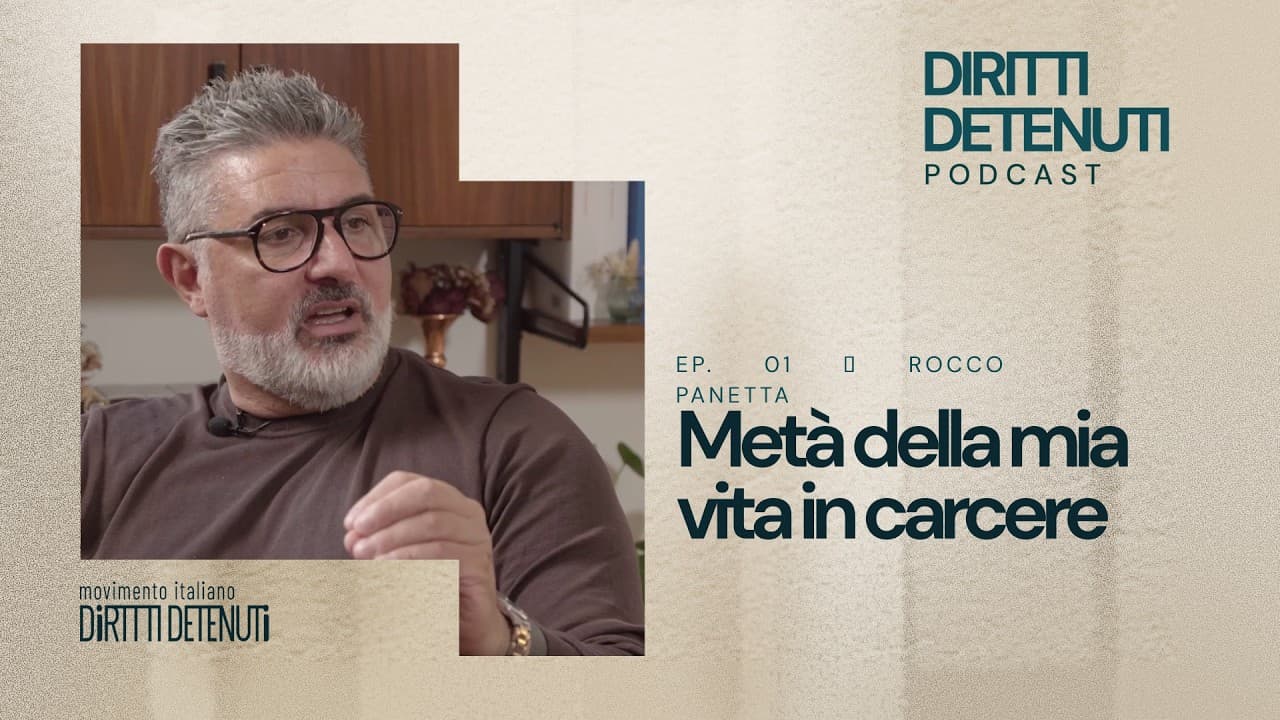
Rocco Panetta tells the story of his life marked by prison, violence and rebirth thanks to school and restorative justice.
Introduction
My story is all made up of limits, you know? I took this limit, I pushed it further and further, further and further, further and further, further and further, until this limit then became a wall. And I was left shut inside the limit. Do you understand?
What is prison for? What effects does it have on the lives of those who inhabit it? On the detained people, on those who work there and on all of us? Every answer begins with a story. A door closes, but what changes inside? What remains outside? And what could go differently?
We will walk through the corridors of the sections, we will enter the cells, we will visit the surgery of a prison doctor, we will go to a meeting with the lawyer, we will take with us the keys that lock and unlock the reinforced doors and then it will be up to each person to answer the question: "What is prison for? This is prisoners' rights." Today's guest is Rocco Panetta.
A childhood in Calabria
Rocco Panetta, thank you and welcome.
Thank you for inviting me. I would start talking about your story beginning from your childhood. What kind of childhood did you have?
So, I was born many years ago, 52 years ago, in Calabria, in a small village in the province of Reggio Calabria, a village between the sea and the mountains. I was born into a very normal family, people who work, because my mum and dad were two people who have always worked, they managed a bakery for 30 years, so let's say an apparently...
M What kind of context was this small village?
Yes, well, obviously Calabria at that time was devastated by the so-called Indrangheta wars, right? If you look at the numbers, so many people died between the '70s, '80s and '90s in Calabria, but so many, so many. So it was not a normal context. I remember that for example to go to school, and I was enrolled at the... back then it was called accountancy school, right? I used to go out and there was a village nearby, Cittanova, where there had been a bloody, terrible war, and when you went to that village you breathed a different atmosphere, right? You were even afraid to interact with people because you never knew who you might have in front of you so it was a different atmosphere. I would say, even if it's improper to say, I lived in a climate of, of, of war as a boy. I remember for example that one day, and this is something I will never forget, I was in one of these villages, always because, as often happened, we had skipped school, I went to a village called Tauri Nova and that day we boys were there and I didn't witness it, but it happened that a person was decapitated, they threw his head in the air and shot at it like clay pigeon shooting with a rifle.
I remember this thing as if it were today. Did you see it? No, I didn't see it. I was there, then I went to the place, but by then everything had already happened and I saw the blood, I still saw the body covered with a sheet, you know? And basically there was the sheet in one place and then in another place where the person's head had fallen another sheet.
So I didn't have a, as I say, serene, peaceful childhood. This is one side of the environment. Then also at family level I had some, some family influences. For example, my dad was an alcoholic who drank and I understood this thing when I started to be 11, 12, 13 years old, you know? And his alcoholism had repercussions on how he behaved at home, how he treated us.
Absolutely yes. There was always, how can I say, daily arguments because my mum obviously got angry, also because they managed a bakery together. Then my dad when he drank didn't go to work and I had to get up at 13 years old and do what he did.
So at dawn, at dawn yes, very early. At one o'clock at night we went to work. But the thing that I think marked me the most is that my dad went out and argued with people. As I grew up I couldn't accept this thing, right? You know? I say, no, he's my father, he's untouchable because I had this idea and I started to act as a father to my father from this point of view, because then at 13, 14, 15 years old I started to build myself up physically and I faced the issues that he created in a different way than he did.
That is, you wanted a bit, a bit to protect him, a bit to avenge him. Yes, a bit to protect him, a bit to avenge him, because in my idea at the time he was my father and he was untouchable, no one could touch him because if they touched him they touched me, so mh I grew up like this having big, serious arguments, but two or three times I came close to something bad because then basically my father started to argue with people he shouldn't have argued with, people who didn't let things go, you know?
In fact at 14 years old I already had a weapon, but I had a weapon not because I wanted to commit crimes, I had a weapon because I was afraid that one day in one of these arguments I could lose my life and so eh I thought your death, my life.
And how does a 14-year-old boy get hold of a gun? At the time it was... So we're talking about the '80s. Late '80s, early '90s. Yes.
So at 14 you already own a gun and then how does your life go on from there? What happens?
So, it goes on that obviously people much older than me, people who maybe found it convenient to have someone like me by their side started to court me, to give me things that today I tell you I didn't deserve, because I was 14, I went around with people of 20, 22, 23, 25, you know?
And they started to take me with them and I went around with people much older than me, also with a structure, people recognised in Calabria, you know? People who you mean criminal structure? Of course. Criminal. Yes, yes, yes, yes, yes. Criminal. Of course. Yes.
And what kind of activities did they ask you to help them with? Anything, I'll tell you one thing, for example, in my village there were two rival groups, right? One of these people had a vintage car that he parked near the Carabinieri barracks. So the other group wanted to damage the car, but they couldn't because it was in front of the Carabinieri barracks.
And so I arrive, a kid, I say, "Look, I'll do it easily, but how are you going to do it? Don't worry, I'll do it." In the evening I take a bicycle that makes no noise. Ta ta ta ta, I arrive in front of this vintage car that has the soft top. I cut the soft top, I filled it with petrol. I threw a Ronson in, those lighters. You know that lighters never go out and all, I stuck it inside this car and it burns.
And weren't you afraid? No, because I was reckless. I was reckless, you know? And that thing put me a bit in the spotlight saying, "Oh, look at the courage he had. He went in front of the Carabinieri barracks, did this thing." That is, little by little you acquired your own role, let's say.
Yes, my own role. Yes, yes, yes.
So you didn't consider prison at that moment, you didn't think about it?
Absolutely not, not even as a joke. But you know what? It's that when you have an ideal, a vision of the world, for you it's normal to do certain things, you know?
Today, for example, when I take a wrong step, that is, wrong, or I realise I'm getting close to the limit, I try not to cross it because I know what it means to cross it, right?
At the time I had no idea what it meant to cross a limit, you know? I crossed it easily, in fact it gave me euphoria, you know? It excited me to cross the limit and then it kept moving further and further away.
But maybe I've told this anecdote a few times, right? That my story is all about limits, right? I took this limit and kept moving it further and further, further and further, further and further, until this limit then became a wall. And I was left closed inside the limit, you know?
The prison that contaminates
And when does prison first come into your life?
So, it comes when I was a kid, there had been a robbery and I was stopped many hours later with the motorbike from the robbery and basically they arrested me for the robbery, but then this thing did not manage to get to trial because there were no grounds and so this was a, it was a brief imprisonment.
Yes, brief, very brief, very brief. And so then you get out and you think "Ok, I’ve dodged this one, I move on." Of course, I move on and I still continue always on my path.
Only you know what it is, for example, look this thing here is really important to explain, because at the time I was arrested in Rome and in prison I had contacts with people who at the time... prison contaminates you, doesn’t it? It negatively influences you. When people talk about the university of crime, I experienced it on my own skin because in Rome I had contacts with people, basically these people "But what are you doing? You do robberies and you get a few quid." But look, we are in a world like this. You are in Calabria, Calabria is the homeland of drugs. Of course, my second arrest was for drugs, but the contact I had in prison.
And so you make this leap thanks to what you learn and get to know in prison.
I take that initial offence which was setting fire to a car, which becomes robbery, which becomes drugs and then leads to much more serious offences.
That last arrest was for mafia-type criminal association, so it was all an escalation, always a succession of offences that always evolved, evolved, evolved, evolved.
The real reason
And how much was the search for money a motive or was that not the point? That was the point, but then I’ll tell you: in the last detention, which is this one here that cost me 12 years, 6, 12 years and 7 months, in the last detention I really had the chance to look inside myself and understand why. If you don’t understand, you always stay in the same place, right? To understand why, I always justified myself by saying: I went to prison because I liked the good life, I liked money, I liked going around, spending, clubs, cars. But this was an excuse I gave myself.
The reason, the hidden, deep one, I understood in this last detention and, and if I tell you, it goes back to adolescence: the conflict I had with my father, you see? I understood that fundamentally I committed crimes because I wanted to transgress, but I didn’t want to transgress against the law, the State, society. I wanted to do it for my dad and I understood this after many years. When I understood it, I mean, a scenario opened up for me that before I couldn’t even remotely imagine, you see? I understood the root cause of why I spent half my life in prison because then all these crimes cost me a nice sentence in prison, between two once, six another and 12 and I spent half my life in prison.
And how did your father react to this career of yours in crime? But my dad fundamentally was always a transparent slip, you see? So even in that situation he never really took a position because he was a person who, when he wasn’t drinking, was uniquely calm and kind.
Then I don’t know because then in my introspection I managed to understand and forgive my father too, you see? Because my dad in turn was a victim of my grandfather, his father, and he had spent time in his life in prison, you see? So I understood that my dad was a wounded child in turn. Grew up a bit without, always grew up without his dad because my grandfather spent more than 30 years in prison, then he even died in prison.
So you went to visit. Yes, yes. So you first got to know prison like that, by going? The very first time I got to know prison, not as a prisoner, I got to know it because I went to visit my grandfather. I went to visit my grandfather, eh, who was in prison for murder and I got to know prison when I was very little.
Do you remember what you thought? What feelings did you have? I remember that I went to visit my grandfather. My grandfather would show up well dressed in jacket, tie and in saying and not saying, because it’s not like they told me “Look, we’re going to prison to visit your grandfather, we’re going to visit granddad.” And for me it was normal that my grandfather was in that place, you see?
But I always saw him well dressed, I saw him as a distinguished person and I had a lot of esteem for my grandfather, right?
Entry and life in prison
Ehm, So, exactly, after the first very brief detention there is this second one and we were saying, exactly, about this second arrest. Yes. How did it happen?
Eh, It was a bit more traumatic than the first, right? Because basically there was a police operation underway and I didn't know. I was stopped in the street. I managed to force the roadblock, to escape. There was this chase.
Then I ended up in a small village in the province of Bergamo that I didn't know, in a narrow street where you couldn't drive anymore and I was obviously arrested in a bad way because then the police officers were very angry about my behaviour, right? Because in their words "Ah, you made us risk our lives." They were killing themselves and so, I mean, because they chased you for a... they chased you.
No, they stopped me and I didn't stop. I forced the roadblock. I mean, it wasn't a real roadblock. I saw some people in plain clothes pointing a gun at me, I was in the car, I went towards them, you understand? I didn't hit him, he jumped, they jumped and then they chased me.
Yes. And where do they take you? They take me to Bergamo, to the prison of... Can you tell us a bit about how an entry into prison happens? What are the procedures, the feelings? What
So, entry into prison without rhetoric is pure violence, because you arrive as a person, you are recognised as a person, you have documents and there in prison when you arrive at the registry you are stripped of all this, stripped both as a right, right? because you are registered, you are given the registration number, but you are literally stripped physically and it happens you are searched everywhere.
You have to do squats, things that are really useless and I don't know and I don't know how to define them. They are humiliating things and you become something else. You are no longer the person you were before, you become something else. You are never called by your first name but by your surname. And everything you do you can't put your name, your surname, but the registration number.
And these first weeks, months of detention, how did you feel? I mean, did you feel in a place where you knew how to move or
But I did, because I felt in a place where I knew how to move because I have always been familiar with prison. Even if the impact, even though you have experience, you have lived the experience of prison, the impact is always violent.
Even if you do it after 2 years, 3 years, 4 years for a second, a third, a fourth detention, the violence of prison always remains.
But you are talking to me about first, second, third, fourth detention, so recidivism, various recidivisms, not in the first, first, let's say, before a change happened inside you, this introspection you talked about, didn't you think: I get out of here and I do everything not to come back, I mean, you got out and what happened inside you?
I got out, first of all, when I was in prison I thought about how not to get arrested when I got out. In fact, before I was telling you about the arrest I had for drugs and we found ourselves in prison with my the people I have always been arrested with, even the last time we were arrested together, right?
And so eh we talked: "Damn, but we are really stupid, damn it, we got ourselves into a crime that is too visible. When we get out we change, we change type of crime, no more dirty clothes, we put on clean clothes, company."
And what choice was it? So it was the choice to do jobs with companies, money laundering and whatever is convenient in a job, in a job, job in inverted commas, for a job and in a type of white-collar crime, let's say. And the evolution was from robbery, drugs, organised crime and all the crimes that are convenient and anyway even this time, even if you had time in prison to think about it and plan everything, anyway you get arrested again, right?
A third time comes this third time and it comes because it comes, I'll tell you why prison we say prison and we think of prison, a model all the same. But prisons are not all the same. Prisons there are prisons as if you go and see and you know very well what I'm talking about. And there are prisons that have one type of recidivism, prisons that have another. There are prisons that give you the possibility to evolve, to grow, to have a function because then basically that's what you need to re-enter society, but then we'll talk about it and I'll tell you my experience of how I reinvented myself.
And prisons instead that give you no possibility. Think that I was, where I told you before, that at San Pietro, Reggio Calabria, there isn't, I mean do you know what kind of school there is? Only literacy, that is, compulsory school and literacy. There is no school, if for example you arrive a boy of 22-23 years old who maybe outside didn't have tools, possibilities and maybe you go to prison, the time you start to study, no, there isn't because they don't give it to you. They don't give it to you. You live in the hour of exercise and in the cell.
Exercise, I mean all the time when you are not at exercise you are locked in the cell. Yes, in that type of prison. Yes, yes, yes, yes.
And what do you do all day? Well, you invent micro-practices to live, I don't know, you clean obsessively and then comes lunch time, dinner time, you wash, clean, do all these things. Then there are those who play cards, those who do other things, those who do crosswords, you invent micro-practices that make time pass and you don't even notice.
In fact, when I talk about prison, about temporality, what is time, how you live time in prison, I say that prison is an eternal present because you do the same things every day, systematically time passes, eh, because it's not that I, for example, in prison I was never bored, time passes and but you don't notice, then you notice after 5 6 7 8 10 years because you look at yourself in the mirror, you are no longer the person who went in.
And what relationship was established with the other fellow prisoners? In prison relationships are on steroids because I for example had, to make you understand, right, relationships I had this co-defendant of mine with whom we had five six proceedings together, now I don't remember, four or five or six proceedings that until we were in the same cell in a prison I realised I didn't know him.
In the cell I met a different person because prison accelerates relationships. Then obviously there are relationships that become lasting, relationships that instead are left at a certain moment.
But I can tell you one thing that you get to know a person as not even husband and wife know each other in prison.
You, exactly, have been free now for 2 years. Do you ever think of any friend, companion still in prison?
Eh, every now and then yes. Every now and then I think of someone. Yes, every now and then obviously I think of them. Yes, yes. Also because then it's useless to say, but there are bonds that you will carry with you for your whole life, you understand? Bonds with even if I don't want to have anything more to do with the world of crime, I don't want to commit crimes anymore, I want to live my life differently. But then there are relationships that are born in prison that are very long.
The other day, for example, I met a lifer whom I've known for 30 years, I've known this guy. We have found ourselves in a lot of detentions in various places in Italy and and he is the person with whom I from Bergamo, when I was detained in Bergamo, I had to escape then because once we had even planned to escape from prison.
Then what happened? It happened that I go to trial, the trial was all based on interception, bugging, environmental bugs and they are declared legitimate because there were no authorisations and I am released. And he however in prison we had set up this this escape and then he really escaped, he managed to escape.
Yes, yes, yes, yes, yes. He got out, he managed to escape, then he was arrested in Marocca. The other day he is on semi-liberty, we met, right, to tell you, you see, these are bonds from 30 years ago and still, for example, this is a bond from 2000, 26 years have passed and they still remain.
Of course, yes, I always think of people, not always, continuously, but it happens that I think of those who those who remained in prison.
Yes.
Violence in prison
And violence. I have my own idea of prison, you know? My own concept. I say: in prison each of us has 1 square metre at our disposal, right? You have to stay in that square metre. When you put your foot in the other square metre I invade your space, you understand? And so there is violence. Absolutely yes.
Then let's leave it, it also depends on the environment where you experience prison, right? Because you know that prison is structured at, let's say, levels, right? There is medium security, high security 1, 2, 3, 41 bis. It also depends on which circuit of the prison you end up in, right?
Because if you go to medium security there is common crime, all the lads who get arrested, even the lads, but for example those you see at demonstrations, lads who live in hardship, they are there and there the rate of violence is very high. People argue over nothing, they argue over a cigarette, they argue over shoes, they argue over anything.
You have also been in medium security, so you have seen both the the Yes, yes, yes, yes. I have experienced them, I have experienced them in medium, in high security. Detention, they are two totally different detentions, apart from the fact that today high security is made up mainly of Calabrian, Sicilian, Neapolitan, Campanian and Apulian detainees. And instead if you go to medium security there is a melting point of cultures, of people, you find eh then that is another problem of prison, right? Because one of the fundamental problems, in my opinion, of prison is that prison is now used both to treat drug addiction and for psychiatric problems.
You find people who really have serious, severe psychiatric problems in prison and it's not that they are... Yes, sometimes they are isolated, but in the vast majority of cases they live together with other people, you understand? And there absurd things happen, like in war, when you take and throw a bomb on a house where there is a family with people in a context of normality, you wouldn't do it, but in war it is done. And in prison it is like that.
There are people who unfortunately have serious problems of drug addiction, of psychiatric problems together with others and absurd things happen. In high security instead there are slightly different logics, perhaps also because the sentences are longer. All security. I'll tell you one thing, all the things that are outside prison are reproduced, right? For example, if there is someone who belongs to an important family, he has his respect both from the detainees and from the guards, because then when you hear that the officers beat the detainees, they don't beat those in high security, they beat the common ones, they beat people who are already in a state of fragility, you understand? Huge, and then they beat those.
Yes. In a previous interview you also told me about all the episodes you witnessed of, precisely, violence by the officers. How common is it, how structural is this thing? It is really, how can I say, it is part of prison, there you go, without using terms, violence by the officers against the detainees is part of prison.
And because people... there is a logic, they feel authorised to do things because, as I was saying before, the person is depersonalised, he is no longer a person, right, he is a detainee and in the vision of the officers the detainee has lost some requirements as a person, right? So if an officer outside his work has to slap a person in the street, I think he would never do it. If he has to do it to a detainee he does it, but he does it because he feels authorised primarily by the uniform, secondly because the detainee is not a subject who has rights like we have today here in this place, you understand? And it's another thing. It's another thing. Yes, it's another thing. Another thing.
And did it seem to you that it was something done according to the arbitrariness of each one, a moment of anger and so an officer on his own reacted violently or was there really a bit of a system?
There is a system, it's called squadretta, everyone knows it, even if they say they don't exist, there are the squadrette. They are squadrette where they take the most violent officers, they are selected by their eh shift leader, I don't know who or how the selection happens. But I know, for example, in the prisons where I have been that those who used violence were more or less always the same, that is, some officers are used who form this squadretta and go to beat the detainees, detainees like almost punitive expeditions. There are, there are punitive expeditions.
Ah, then the history of prison teaches it, right? There are even books written about it. I, for example, invite you to read Cella Zero which was written, now I don't remember, he was also the detainees' guarantor in Naples who is a former detainee. Now I don't... Ah, yes, yes, I don't remember either. And in practice cell zero was a cell that was in the prison of Poggio Reale that didn't have a number. When they had to beat a detainee they would say "let's take him to a cell zero", the cell without a number where they used it to beat the detainees and this cell zero is a bit everywhere, right? The places where they take you, where no one sees you, not even the other detainees see you, there are no cameras.
I remember once that something happened, I want to tell you, opera. We were coming back from the yard and there was a very impetuous officer, very eh overbearing, eh he was always looking for an excuse to, I don't know, to make you uncomfortable. That's it. So a detainee who is hot-headed, we go up from the yard, high security, I will never forget it. Luciano who was a bit hot-headed. This time I don't remember what he did to him, eh. Go on, he said, speak properly what did you say? The officer comes closer like this. As he comes closer, Luciano? He raises, I swear, he slapped this officer so hard that even today I still hear the sound and he made his glasses fly, I don't remember how many metres, right?
And then all the officers arrived. So we high security detainees all rebelled, I said "No, you touch him, you mustn't beat him, because if you beat him we will all rebel". And they didn't touch him, they didn't touch him, they took him to isolation and then you know that in prison there is the radio prison, right? Through workers, people who work.
Explain to us what this Radio Carcere is. Radio carcere, the voice of the prison. All the news. Prison, as you know, there is no technology, at least apparently there isn't. Then today the news says otherwise but it's not like you can.
So there is the radio Carc, there is the worker who speaks. Worker are the people who work in prison because then there is a whole language of prison, right? They come. The so-called trivialisation, infantilisation of prison is made above all of language, eh right? Everything is declined into something that is small, petty, right?
The worker, for example, the person who works is the worker through workers and through people who are in a certain place, there is this word of mouth and Radio Carcere works like this, right? The word is passed on. I have to say something to a person in another wing, in another section, I can't go into the corridor. So I tell the person who works. The person who works goes, the one who works is in... Eh well, the roundabout is a bit the structure of the prison, right?
From which the wings start. From which the wings start and they communicate like this, right? Between the worker of the roundabout and the worker of the section and the news arrives.
And so for Luciano we committed ourselves with a promise to the prison that if they had beaten him we would all have rebelled and they didn't beat him. This to tell you, right? It will be a person, for example, of medium security, squadretta, massacred.
The change: restorative justice and school
massacred. After these years in which you are in prison, but in some way you continue to think about your life, eh, having made a choice, at a certain point something changes. How come? Where does this change come from?
Well, basically the change comes because it starts, well, there are many ingredients, right, but the fundamental ones are that firstly I had grown up, the age, I was a parent, but above all because I started to go to school, to study, to really understand what a right is, because before, in previous detentions, we only talked about rights, but we didn't know that a right corresponds to a duty, right? So we only talked about rights, I understood that it corresponds to a duty, but above all I participated in restorative justice meetings, right?
Where there was the lady who was a victim of crime, for example, in a bank and she would tell you "I did, I had bank robbery offences". Right, in my head when I entered a bank I wasn't stealing from anyone, right, I was stealing from the bank's capital. Of course, even in my head it was like that, right, but it's not like that because you go in, there are people there and maybe there's a lady who is pregnant and could lose the baby from the shock. There's the person who maybe has to go to a psychologist for life because you shocked her with your entry into the bank, you understand? Or the employee who will never recover from the fear of it.
And you don't understand this thing? You say, after all, I'm stealing from the capital, the bank belongs to no one, there are shareholders, I'm stealing from a capital and then instead you see the lady who tells you about the violence she suffered and you start to understand, you put yourself in the other's shoes, right? You step into the other's shoes and you start to understand that you are doing violence to others, right? And this thing becomes a small brick in the puzzle.
Then, instead, the normal process doesn't put this, that is, criminal justice, this responsibility, absolutely not. Absolutely yes. And not, criminal justice deals with cognition, with talking about the crime. You don't talk about the person, you talk about the crime, right? You understand? You are convicted, you don't talk about people, you talk about crimes and that's it.
Eh, the victims are made civil parties. It's not that you talk to the person, she tells you what she suffered, no, you talk about law, about crime, you don't talk about the person. Restorative justice instead, at least from what I understood, concerns people, you understand? It puts you in connection with each other and you really understand what maybe a gesture is that before you can't, with the tools you have, you can't understand that you are creating violence in the other person, right?
So, you understand this, but then from my point of view the thing that emancipated me the most was school, starting to study. In prison instead for a reason, when I enrolled in school, I enrolled at Opera and at Opera at the time we were locked in the cells 20 hours out of 24, right?
And so one day on the noticeboard, because what happens? When I was at Opera in 2013 you could enrol in one circuit at a time because you can't meet with other people. The school was one, it was done one time for high security three, one time for high security one. And until the 5 years were over you couldn't enrol in school.
That year it happened to me on the noticeboard. It's like a solar eclipse that happens only every 5 years. Eh yes, that's how Opera worked. You could enrol in school either S1 or S3. That year it was S3's turn. What choice do you have for this school? But you know, always locked up. Then my friends told me that at school there were these teachers, girls, beautiful girls. I say damn, you get out of the cell and maybe you know, you also come back with your eyes a bit, with a different vision, here, from that of your fellow sufferers.
And these two, these two, these two things, these two factors made me enrol in school. I swear to you, I enrolled in school to escape from the cell, from the cell and then because there were the teachers, if that's the reason.
Then instead school, damn it, it, how can I say, it kind of tricked me because little by little I started to get passionate, to understand certain things. Above all I started to broaden my perspective, to learn things I didn't know and knowledge led me to take that step that without knowledge I would never have taken, right?
That is, thanks to school for the first time you questioned your... My ideas, yes, absolutely yes. My beliefs, my ideas. I questioned everything through school.
I say, then there isn't a key moment, that is, I don't really remember a moment, but I remember that after many years eh I tried to recognise my thoughts, you understand? I say, "Damn, but why did I get there now, I didn't get there before?" But, as I told you, change is a rich dish, it needs many ingredients, but these that I'm telling you, from my point of view, are fundamental, but fundamental to participate in restorative justice paths, to study and to start doing introspection. Was it painful to rethink your past with this new awareness? Absolutely yes. Of course it was painful, but spiritually from my point of view I destroyed, I had a family, I had a life outside there, I destroyed everything with, that is, everything imploded on me, you understand? I lost my wife, I lost my daughter because my daughter then grew up far away, we separated, even now there are disastrous relationships, here, I say so disastrous because I was never able to rebuild a parent-child relationship. How many years have you spent in total in prison? And if I do the maths it's about 22 years slash, among all the detentions, if I put them together 22 23 years, I wouldn't know, something like that. Half of my life I have, I have, I have spent in prison. Yes.
Leaving prison
What does one feel when one is... Oh my goodness.
So, in the vast majority of people, then I'll tell you about my experience, whom I have known, they are terrified of really getting out, that is, terrified of leaving prison because you get out and you are disoriented. Prison makes you tabalia, right? You, you don't have to provide for anything. Then when you get out there are all the problems.
Anyway, as soon as you get out, yes, freedom is wonderful, but I tell you that before getting out it scares you. I get out, I get out the last detention from Asti. I get out because I had semi-liberty, I was given semi-liberty for study reasons. I was then the first in Italy also to obtain this type of semi-liberty because it did not exist, but for a series of reasons that now I'm not here to explain to you, all sorts of situations combined.
I was in Milan, I was studying, they transferred me to Asti, Asti did not have the prison hub. The educator was convinced that instead that path for me was optimal regarding the terms of recidivism or not recidivism because she saw that I was studying with profit and so one day I made a joke to her, I say: "Doctor, but what do you say if we do semi-liberty for reasons of" study?" and she says to me "Look, there is not a precedent in Italy, for reasons of we have checked."
Basically what happened? We put, me on my side, the educator, the criminologist, all the prison team, favourable opinion, we went to court, basically the right to work was equated, the right to study, right? Because you go out for the right to work, but also the right to study could be... I obtain this semi-liberty in Asti and they send me to Opera because the state university in Milan I to prove to myself that I had not lost my social skills I tell my family that they cannot come to pick me up, that I have to go alone, that I am obliged but it is not true, I made it up because I wanted to go back alone to see if I could do what I did before by myself, right?
After how many years? 10, 10 straight. In fact my companions said to me "No, you know, once I was released in Rome, I went, arrived at the station, I had a panic attack from long detentions we are talking about." Another told me another story of who knows, let's see, right? And instead damn, I get out and it's nice, I start to look at nature, I get a taxi called by the assistant, there was a female assistant, I say, "Excuse me, please, can you call me a taxi because I have to go to the station?" Yes, yes, yes, yes, yes.
At the porter’s, they call me a taxi, the taxi arrives, I take the taxi, I go to the station and the taxi driver says to me "Have you come to visit a relative?" "No," I say, "I am the relative. It's as I say, it's me. They have released me, I am going to Milan." Ah, all right.
I had such a desire to see, I can't tell you, I took the train, I wanted to look. You know that on the train you look, there is the window on the right and on the left. I wanted to look at both sides, I didn't want to miss anything, right? from the dalgo.
Eh, it's something that in prison I didn't know I missed. Do you know what they were? The cornetti, the croissants. I ate croissants all day from Asti to Milan, station, everywhere I ate croissants.
Anyway I arrive at Opera, right, to tell you how much, but and sorry the impact with the central station, with the traffic, the people yes, yes, yes, yes, absolutely yes. The impact is a bit eh yes, you feel it. I can tell you that you feel it, you feel it and but then you know what it is? Because in prison there is something that penalises you a lot and that you do not see colours. For example, this yellow here is difficult for you to see: everything grey, green, bluish, you understand? When you get out you see all the colours running, the cars going, life flowing. I... Eh yes, even after 10 years anyway seeing again that half the population is made up of woman. of women, it's true, of course, you get distracted obviously there is no doubt and it is impactful, but the thing that struck me most is when I went out then the first day to go to university, right?
I had to take public transport, go to the university, when I arrived at the Statale there was Doctor Dell'Loca who works at the Statale who was waiting for me, right? And she says to me "Come, I'll show you the Statale university" and she says to me "Do you like it?" "Wow, I like it". It was beautiful. But after years and years of prison building you find yourself in a structure like the Statale, for me it was the seventh wonder, I looked on in ecstasy all right, let's go round the perimeter.
And this is what I wanted to tell you. Do you know what happened to me? I don't know if you have a dog or I see that dogs don't walk on grates.
I didn't walk on the grate, I was afraid to walk. You know that in front of the sta terra there are all the grates and I was walking and Chiara said to me: "But go on Chiara, I can't". How could I not walk on the grates? I mean, I felt, I was unwell and I was like that, I had lost that thing that today I don't even notice where I go around I walk calmly.
I couldn't walk on the grates because for so many years you get used to reinforced concrete and there instead there are these big grates where you see underneath and I couldn't go over them. It's traumatic. It's traumatic to get out of prison because you are taken from a reality that is not life. You are thrown into daily life, you understand?
You had a network outside, anyway you had a welcoming environment. I yes, fortunately a family with whom I have always had relations, then when I got out there was the girl who was waiting for me because that is a very important part, right? It is decisive regarding how life can go afterwards, that is, having people, a network, a it is fundamental. It is fundamental.
It is normal that if the person gets out of prison and has no reference and has nowhere to go, nowhere to sleep, nowhere to eat. But do you know how many people there are in prison who are, eh, how can I say, they are eligible to access benefits and so on and they do not have a family outside?
And if you do not have a family outside you cannot you cannot have, you cannot have house arrest, you cannot benefit from permits. Yes, there are associations, but the associations cannot cope with all the requests you have, you understand?
Indeed, even in Asti I met an extreme case, an Indian boy who had his family in India and he worked in the laundry. Since in Asti there were good salaries in prison, unlike other institutions, he earned like €900 a month, he never requested early release so as not to get out of prison, because he says from prison: here I don't pay rent, I don't pay for food. Plus €900 I send every month to my family in India and he did not request early release, which is the period you accrue for good behaviour every 6 months you accrue 45 days off your sentence, because he had no one, his family was in India and he sent the money to India, but it's an incredible thing.
He, for example, did a year and a half, two more of detention than he should have done because he never requested early release.
And think if you prefer prison, that is, if prison seems to you a better scenario for your life than freedom, it means that freedom eh... But this I tell you, this is to say, if you do not have a network, if you do not have a family, if you do not have anyone and then it is difficult to return to society and integrate as a citizen.
Here, you will always remain the person you were before.
A society without prison
Rocco, you have told us your story, which is also a story of great questioning, of redemption, of reconsideration. It does not always happen.
I wanted to ask you to do an exercise of imagination, to imagine a future in which justice is something else. Can you imagine a society without prisons?
Well, I can imagine it, I dream of it, yes, and I would dream of it, yes, a society without prison, but to imagine it as things are today is really something difficult, but it is not difficult for me, it is difficult for people, because we have an idea of justice that is a bit, how can I say, first of all it is outdated, atavistic, old, right? We still think, I took your glass and you have to hurt me for the harm done, you see? Justice in this sense here and it does not work.
I think that people, not me, I am sure that I can imagine it also because there are alternatives, for example, there are Brazilian prisons that are totally managed by prisoners in a different way, right? There are no officers. The officers are outside the structure. There could be communities, many things could be invented. You see how there are communities for drug addicts, communities could be invented for minor offences, yes, it could be done, but society is not ready for this, so I think it is something
And what remains with you from this experience? When you think of prison, do you think of one thing, do you think of many things. What feeling does it arouse in you? Do you feel it as an experience or does it still torment you?
a I have an ambiguous relationship with prison, I feel it as home and not home. I felt it for many years, it was my home, but do you know what it is? That then in prison you try to reproduce all that is your life, right? For example, the dishes your mother made you as a child, things, and so for many years I felt prison as home.
Now, at this moment, it seems like something that no longer belongs to me, but inside myself I know that it is a place where I grew up, I did a lot, I emancipated myself, I, but even from myself I emancipated myself in prison and so I live it, it arouses in me this feeling of, how can I say, of closeness. I feel very close to prison.
I in my opinion, in fact one of the things that I think is intelligent that a professor whose name I will not mention said, when one speaks of prisoner, ex-prisoner, so if one, excuse the vulgarity, is an arsehole, then starts to behave, what is he, an ex-arsehole, right? So he says: there is no ex-prisoner, it is a person who has experienced the... in fact, as Professor BZ Dinger says, and "I have experienced prison in my life and it is part of me", right? Today, if I am who I am today, it is also thanks to prison.
Thank you Rocco. No, thank you for inviting me and I just hope it is useful for something.
I am sure it will be useful. Thank you.
You have listened to Diritti detenuti, a podcast of the Italian movement Diritti detenuti. The interviews are conducted by me, Isabella De Silvestro. The editorial production is by Marina Beraha. The direction is by Stefano De Felici. The audio and video recordings are by Am TV.
What it covers
Laws cited
- Art. 27 Constitution — It establishes that criminal responsibility is personal, that the defendant is not considered guilty until the final conviction and that punishments must aim at the re-education of the convicted person.
- Art. 41-bis Penitentiary Regulation. — It provides for a special prison regime for particularly dangerous detainees, limiting contacts with the outside and rights within the prison.
- Early release (art. 54 Penitentiary Regulation) — It allows a reduction of the sentence for good behaviour, with a discount of 45 days for every 6 months of detention.
Keywords
- prison
- recidivism
- restorative justice
- prisoners' rights
- penitentiary violence
- social reintegration
- education in prison
- depersonalisation