The experience in prison reveals the humanity of the detainees and the importance of telling stories of redemption, often ignored by the media.
Entry into prison
In 2021 I entered prison for the first time. I entered with the prison project of the University of Milan, a project that aims to accompany students who graduate inside penal institutions thanks to the help of tutors who provide them with study materials and who organise exams for them with the professors.
I came to this project almost by chance, partly out of curiosity, I confess, that somewhat indiscreet curiosity that leads us to be somewhat fascinated by the world of crime, the world of prison and also partly by the desire to make myself useful and to put my knowledge at the service of something more beautiful and greater.
A new way of seeing the world
This experience has decisively reoriented my way of seeing the world of detention. In fact, upon entering prison I realised that inside there are people. I know it may seem like a somewhat banal realisation. Now I laugh about it as I think you might laugh about it too. But at the time it did not seem like a banal realisation.
When I say that there are people in prison, I mean that in prison there are neither second-class people nor people who are in some way deficient. There are indeed people who have made mistakes, who have also committed atrocious acts, sometimes acts that we struggle to imagine, but always people.
The responsibility of awareness
Starting from this awareness means taking responsibility for these people and for how these people are treated.
From that moment onwards I began to inform myself about the world of detention, as well as entering prison regularly and, through the reports and let’s say all the analyses carried out by associations such as Antigone, such as Nessuno Tocchi Caino, such as the reports of the National Guarantor of persons deprived of liberty, I began to deepen my understanding of the world of detention.
Since it is a world full of distortions, in Italy today we have 70% recidivism. 70% means that the system does not work and that it systematically produces more criminality.
In Italy, violations are perpetuated daily from the point of view of rights concerning both health, affectivity, the right to work, to study, to reintegration, in short all those human rights that should be guaranteed by the Charter of Human Rights.
Perhaps the most serious thing in all this is that it is spoken about very little. The narrative that passes through the media about prison is always very stereotyped. It is spoken only of a lack of security and there are calls to increase the number of prisons as if this could solve the problem, instead of bringing to public attention what are the real problems of our country.
I want to tell you a story because I know that it is a story that does not reach, it is one of those stories that is not told through the traditional narrative.
The story of a detained student
I have been following this student for several years now and he has been convicted of terrible crimes, but he is something more than just a person who is currently detained.
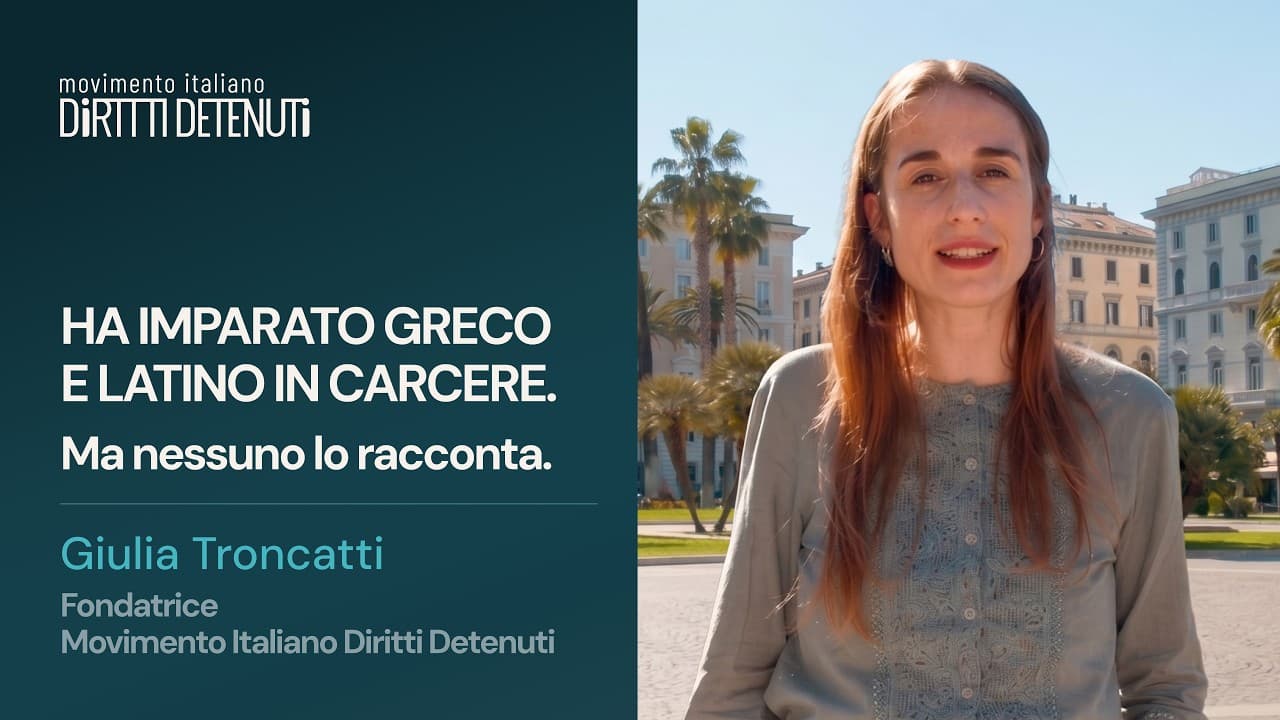
He is also a person who studies, who has found in the classics a way to redeem himself and to rethink himself and his own crime. He is a person who has taught himself Greek and Latin inside prison and it makes one smile because when I met him, even I could hardly believe that he had managed to accomplish this titanic feat.
Stories that are not heard.
And yet it is so.
And you probably will not hear this story because the news programmes do not say these things, and yet he is an example of many. So I think these stories should be told and deserve to be listened to.
The Italian movement Diritti detenuti was born precisely from this desire, that is, from a common desire cultivated by me and by other detained and ex-detained people to bring a different narrative about prison, a more realistic narrative. People must understand that prison concerns us and concerns us even if we do not have a relative who is in detention, it concerns us even if we ourselves have not experienced detention, it concerns us as citizens.
The birth of the Movimento Italiano Diritti detenuti would not have been possible if there had not been the support of the Fondazione Laura Alberto Genovese.
What it covers
Laws cited
- Art. 27 Constitution — It establishes that criminal responsibility is personal, that the defendant is not considered guilty until the final conviction and that punishments must aim at the re-education of the convicted person.
- Charter of Human Rights — International document that protects the fundamental rights of every person, including the rights of detained persons.
Keywords
- prison
- human rights
- recidivism
- detention
- rehabilitation
- media narrative
- prisoners' rights movement
- study in prison

Who speaks
Giulia Troncatti